Waiver of Subrogation
Paste the insurance paragraph from your contract to see whether it asks for a waiver of subrogation, and read what that request means in plain language.
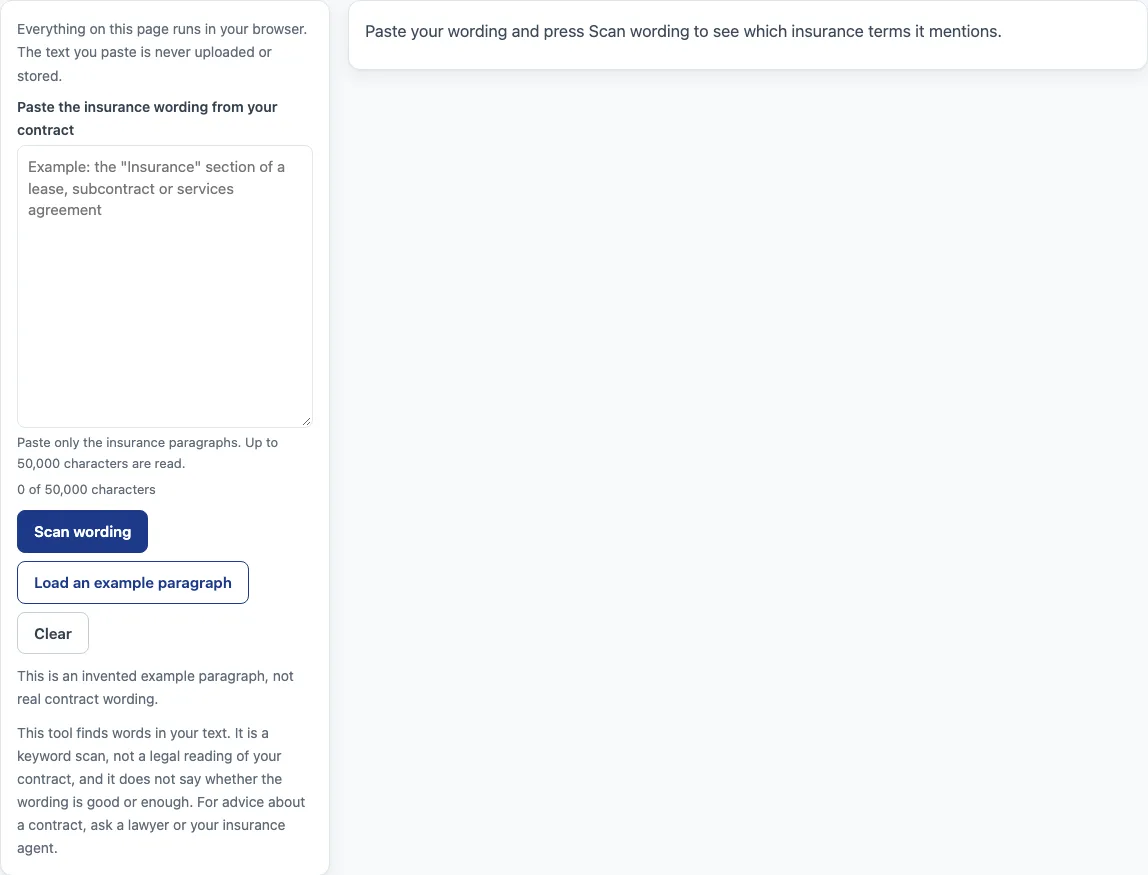
How to use the waiver of subrogation checker
- Click the box labelled “Paste the insurance wording from your contract”.
- Paste only the insurance paragraphs. The counter under the box shows how many characters you have used, up to 50,000.
- Press “Scan wording”. The results also update shortly after you stop typing.
- Read “What your wording mentions”. The first card is “Waiver of subrogation”. It shows “Found” or “Not found”, quoted text from your wording, what the term means and what to ask for.
- Open “Other insurance terms in your text” to see the remaining terms, and “Notice periods in your text” or “Dollar amounts in your text” if those sections appear.
- Press “Load an example paragraph” to see a sample. The example is invented. Press “Clear” to empty the box and start again.
The tool only reports the words it finds. A term marked “Found” does not mean the policy has that coverage, and it does not say whether the wording is good or enough. Wording the tool does not recognise is reported as “Not found”. Only the first 50,000 characters are scanned. Try the example first if you want to see how the results look before you paste your own wording.
What does waiver of subrogation mean?
A waiver of subrogation is an insurer’s acknowledgment that it has no right to subrogate against a liable third party. Insurers usually give one because the insured has already given up its own right to recover from that party.
Invented example: a painter’s equipment is damaged in an owner’s building, partly through the owner’s fault. The painter’s insurer pays the painter. Normally the insurer could then try to recover that money from the owner. If the painter has already agreed not to seek recovery from the owner, the insurer gives up its right to recover as well.
Who gives a waiver of subrogation, and when?
The insurer gives the waiver. Timing matters. A waiver made before a loss generally does not bar coverage, while many policies exclude coverage if subrogation is waived after a loss. A law-firm bulletin says the standard general liability form permits waivers in writing and before a loss occurs, and it warns that waiving without the needed steps can lead to a denial of coverage. Parties that benefit from the waiver may ask for the insurer’s waiver as proof.
A form commonly listed for this on general liability policies is ISO CG 24 04, titled Waiver of Transfer of Rights of Recovery Against Others to Us. According to a retailer’s listing of the form, it adds a waiver to the general liability policy and does not add additional insured status or primary and non-contributory wording. Check the edition on your own policy.
What is the SUBR WVD box on a certificate?
The standard certificate form, ACORD 25, has a coverage table with a column labelled SUBR WVD. ACORD is a trademark of ACORD Corporation. This site does not provide, host or copy the form. The form’s printed text says the certificate is for information only, confers no rights on the holder and does not change the policies. It also says that if subrogation is waived, certain policies may require an endorsement, and a statement on the certificate does not give the holder those rights in place of the endorsement.
One city’s checklist asks that the workers compensation subrogation box be marked, and that waiver coverage be shown by actual endorsements with the policy number printed on each. That is one city’s checklist, not a universal rule. State law varies.
Sources (checked 16 October 2026): IRMI glossary · Taft Law bulletin · ACORD 25 printed text, National Park Service · City of San Diego checklist · CG 24 04 listing, Jones (secondary, check the edition on your policy)
Frequently asked questions
Why do contracts ask for a waiver of subrogation?
An insurer usually gives a waiver after the insured has already given up its own right to recover from that party, and the party that benefits may ask for the insurer’s waiver as proof that the insured’s coverage was not negated. This page does not cover other reasons behind a contract request.
Can I waive subrogation after a loss?
Many policies exclude coverage if subrogation is waived after a loss, while a waiver made before a loss generally does not bar coverage. Ask your insurer and read the policy before agreeing to any waiver.
Does a waiver of subrogation make me an additional insured?
No. According to a retailer’s listing, ISO form CG 24 04 does not add additional insured status or primary and non-contributory wording. The form’s printed note says that additional insured status needs additional insured provisions in the policy or an endorsement.
Is my contract text uploaded?
No. Everything on this page runs in your browser. The text you paste is never uploaded or stored.
Does a box marked on the certificate prove a waiver is in place?
Not by itself. The form’s printed text says a statement on the certificate does not confer rights in place of an endorsement, so ask for the endorsement itself.
Related pages on this site:
- Primary and non-contributory - when the contract also asks which policy pays first.
- Additional insured endorsement - when you are named as an additional insured.
- Certificate holder vs additional insured - when you are unsure which one applies.
- ACORD 25 checker - when you want to compare a certificate with your contract.
- How to read a certificate of insurance - when you need the SUBR WVD column and other boxes.
- Insurance requirements letter - when you want to ask for proof in writing.
- Certificates of insurance - the hub for every tool here.
- Certificate of insurance sample - a made-up certificate explained part by part.