Universal Life Insurance Calculator
Type the premium, death benefit, cost of insurance rate and credited rate from your illustration to see the policy value year by year and whether it runs out.
How to use the universal life insurance calculator
- Type the “Premium you plan to pay each year ($)” and the “Years you pay premiums”. The page spreads the premium over 12 months.
- Enter the “Death benefit ($)”. The page treats it as level.
- Type the “Cost of insurance rate in year 1 ($ per $1,000 per month)” from the policy or illustration.
- Enter “Interest credited (% a year)” and the “Years to project”.
- Open “More options” to add “Policy value today ($, optional)”, a “Premium charge (% of each premium, optional)”, a “Monthly policy fee ($, optional)” and a “Yearly rise in the cost of insurance rate (%, optional)”.
- Read “Policy value at the end” and “Does the policy lapse?”. The table below shows each year up to 10, then every fifth year.
- Use the chips “Underfunded policy” and “Premiums for 10 years” to see how a low premium or a short payment period changes the result.
The page keeps your rates fixed, apart from the yearly rise. Real policies change charges and credited rates.
Everything updates as you type, and the address bar keeps your settings, so you can copy the link or print the result. Run the page twice, once with the guaranteed rates from your illustration and once with the current ones, to see how far apart the two policy values are. If the result says the policy lapses, try a higher premium or more premium years to see what keeps the value above zero.
How does a universal life policy value work?
The NAIC’s Universal Life Insurance Model Regulation defines the policy value as the amount to which separately identified interest credits and mortality, expense or other charges are made. A universal life policy, it says, has those credits and charges made to the policy as separate items. The annual report the model asks for shows the policy value at both ends of the period and each amount credited or debited, by type, such as interest, mortality and expense.
This calculator follows that idea month by month. It adds the premium less the premium charge, takes out the monthly policy fee and the cost of insurance, then adds interest. The cost of insurance is the net amount at risk divided by 1,000, times your rate. The net amount at risk is the death benefit minus the policy value, never below zero. Insurers differ in timing and in what they use for that amount, so your illustration decides.
What does the default example show?
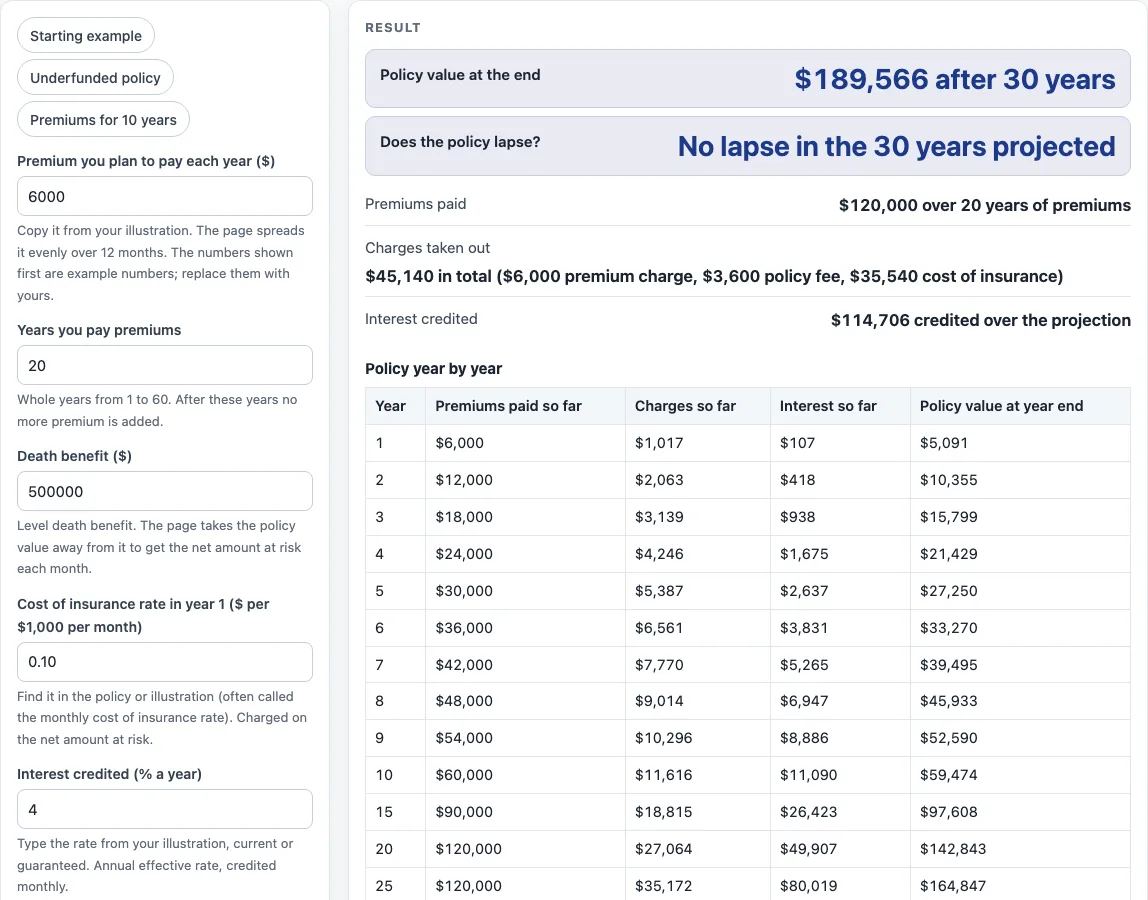
With the example numbers (not a real policy), $6,000 a year for 20 years, a $500,000 death benefit, a 5% premium charge, a $10 monthly fee, a rate of $0.10 per $1,000 rising 6% a year and 4% credited, the policy value is $5,091 after year 1, $59,474 after year 10, $142,843 after year 20 and $189,566 after year 30. Over 30 years the premiums paid are $120,000, charges are $45,140 ($6,000 premium charge, $3,600 fees and $35,540 cost of insurance) and interest is $114,706. Paid, less charges, plus interest equals the final value.
When does a policy lapse in this calculator?
The page reports a lapse in the first month the policy value is zero or less after the monthly deduction. In the “Underfunded policy” example, $1,200 a year with a rate of $0.15 per $1,000 rising 10% a year, the value runs out in policy year 4, month 7. The NAIC model says a flexible premium policy has a grace period of at least thirty days, and that lapse is when the net cash surrender value first equals zero unless the policy says otherwise. This page uses the policy value, which is a simplification, so read your policy’s lapse terms.
What do the optional boxes do?
“Policy value today” starts the projection from an existing balance instead of zero. “Premium charge” removes a percent of every premium before it is added. “Monthly policy fee” is a flat amount taken each month. “Yearly rise in the cost of insurance rate” raises the rate by that percent each policy year; leave it empty for a flat rate. The “Premiums for 10 years” chip, with $12,000 a year, a $250,000 benefit and 3.5% credited, gives $180,744 after 20 years, with $74,653 of interest.
Sources (checked 19 October 2026): content.naic.org
Worked examples
| Input | Result |
|---|---|
| $6,000 a year, 4% credited, 30 years | policy value $189,566 after 30 years |
| $1,200 a year, 4% credited, 40 years | lapses in year 4 |
| $12,000 a year, 3.5% credited, 20 years | policy value $180,744 after 20 years |
Calculated by the tool above; open it with the same values to see each step.
Frequently asked questions
Is this a universal life insurance quote?
No. It does arithmetic on the numbers you type. It does not price a policy or know your health, age or insurer, and results are estimates only.
Which rates should I type: current or guaranteed?
Either. The page uses exactly what you type. Run it once with the guaranteed rates and once with the current ones from your illustration to see the range.
Does it handle an increasing death benefit?
No. It treats the death benefit as level, so the net amount at risk is the death benefit minus the policy value. A policy with an increasing benefit works differently.
Why is the policy value lower than the premiums early on?
The premium charge, monthly fee and cost of insurance come out before the remainder earns interest. In the default example the value after year 1 is $5,091 on $6,000 of premiums.
Is anything I type uploaded?
No. The calculation runs in your browser and nothing you enter is sent anywhere.
What does “Premiums for 10 years” show?
It stops premiums after 10 years and keeps projecting for 20. In that example the policy value after year 20 is $180,744, so the value keeps growing from interest after the premiums stop.
Other life insurance calculators on this site:
- Personal insurance calculators - the full list.
- Whole life insurance calculator - cash value and implied return from an illustration.
- Term life insurance calculator - totals and cost per $1,000 for a term quote.
- Life insurance cost calculator - scale and compare quotes.
- How much life insurance do I need - three ways to size the benefit.
- Mortgage life insurance calculator - a decreasing benefit that follows a loan.