Term vs Whole Life Insurance Calculator
Type a term premium, a whole life premium and the cash value in a year to see what the difference grows to and the return it needs.
How to use the term vs whole life insurance calculator
- Type the “Term life premium ($ a year)” from a written quote for a level term policy.
- Type the “Whole life premium ($ a year)” from the illustration of a whole life policy with the same death benefit.
- Enter the “Years to compare” and the “Whole life cash value in that year ($)” from the illustration. Use a year that falls inside the term.
- Type the “Return you assume on the difference (% a year)”. It is a guess, so try several values.
- Optionally open “More options” and type the “Death benefit of both policies ($, optional)” to see each premium per $1,000.
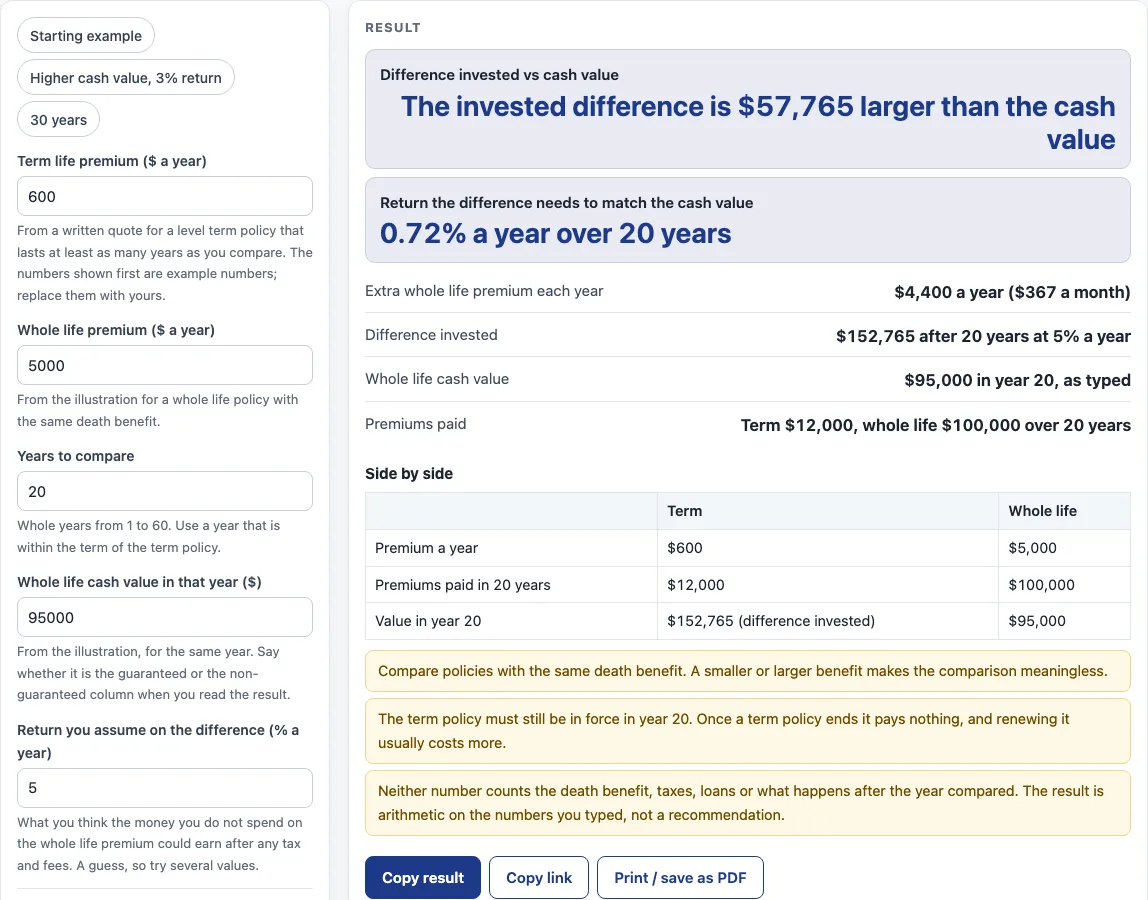
- Read “Difference invested vs cash value” and “Return the difference needs to match the cash value”.
- Use the chips “Higher cash value, 3% return” and “30 years” for other examples.
The whole life premium must be larger than the term premium, or the page shows an error.
Everything updates as you type, and the address bar keeps your settings, so you can copy the link or print the result. Change the assumed return to see how much the answer depends on it: the cash value stays fixed while the invested difference moves. Run the page twice with the guaranteed and the non-guaranteed cash values from the illustration. The steps under the result show each calculation, and the table at the bottom lists the two policies side by side.
What does term vs whole life compare?
The NAIC Life Insurance Buyer’s Guide says term insurance is intended to provide lower-cost coverage for a specific period, and that most term policies don’t build up cash values. Cash value insurance may be more cost effective for a longer period. This page turns that into arithmetic: the whole life premium minus the term premium is the extra amount you would pay each year, and the question is what that amount could grow to if you did not spend it on whole life.
How is the difference invested worked out?
Each year’s difference is treated as paid at the start of the year and growing at the return you type. After y years it is difference x ((1 + r)^y - 1) / r x (1 + r), or difference x y at 0%. With the example numbers (not real quotes), $600 for term and $5,000 for whole life, the difference is $4,400 a year. At 5% for 20 years it grows to $152,765. At 3% it grows to $121,777, and at 0% it is $88,000.
What return does the difference need?
The page solves for the yearly return that makes the invested difference equal the cash value you typed. With a $95,000 cash value after 20 years on the example numbers, that return is about 0.72% a year. At a cash value of $160,000 it is 5.40%. At $88,000, equal to the premiums paid, it is 0%. This is a break-even figure and says nothing about which policy suits you.
What does this comparison leave out?
It assumes both policies have the same death benefit and that the term policy is still in force in the year compared. A term policy pays nothing after it ends, and renewing it usually costs more. It leaves out taxes, policy loans, fees on whatever you invest and what happens after the year compared. Ask for an illustration that shows the guaranteed and non-guaranteed values, as the NAIC guide suggests.
What do the example chips show?
“30 years” uses a $900 term premium, a $3,600 whole life premium and a $95,000 cash value after 30 years. The difference of $2,700 a year grows to $226,265 at 6%, and the return needed to match the cash value is 1.01% a year. “Higher cash value, 3% return” uses a $160,000 cash value for the 20-year case and a $500,000 death benefit, so the invested difference is $121,777 and the premiums per $1,000 of benefit are $1.20 for term and $10.00 for whole life.
Sources (checked 19 October 2026): insurance.ky.gov
Worked examples
| Input | Result |
|---|---|
| term $600, whole life $5,000 a year, 20 years | difference invested $152,765, cash value $95,000 |
| term $600, whole life $5,000 a year, 20 years | difference invested $121,777, cash value $160,000 |
| term $900, whole life $3,600 a year, 30 years | difference invested $226,265, cash value $95,000 |
Calculated by the tool above; open it with the same values to see each step.
Frequently asked questions
Is this a term or whole life quote?
No. It does arithmetic on premiums and cash values you type, and results are estimates only.
Which cash value should I type: guaranteed or not?
Either, but use the same column consistently. Run it with the guaranteed column and again with the non-guaranteed one to see the range.
What return should I assume?
The page suggests none. It is your guess about what the money could earn after tax and fees, so try several values.
Why must the whole life premium be higher?
The comparison is the extra amount the whole life policy costs each year. If the whole life premium is not larger, there is no difference to invest.
Is anything I type uploaded?
No. The calculation runs in your browser.
Can I use it for a policy with a shorter term than the years I compare?
No. The term policy must still be in force in the year you compare, because after it ends it pays nothing. Choose a number of years that falls inside the term.
Does the page say which policy is better?
No. It shows the difference, what the difference could grow to at the return you type, and the return needed to match the cash value. The choice depends on your needs, health, taxes and the policy terms, which the page does not know.
Other life insurance calculators on this site:
- Personal insurance calculators - the full list.
- Term life insurance calculator - totals and cost per $1,000 for a term quote.
- Whole life insurance calculator - cash value and implied return from an illustration.
- Life insurance cost calculator - scale and compare quotes.
- How much life insurance do I need - three ways to size the benefit.