Term Life Insurance Calculator
Enter the coverage, term and the premium you were quoted; the page gives total premiums, cost per $1,000 a year and, with your age, the chance of death in the term from a public life table.
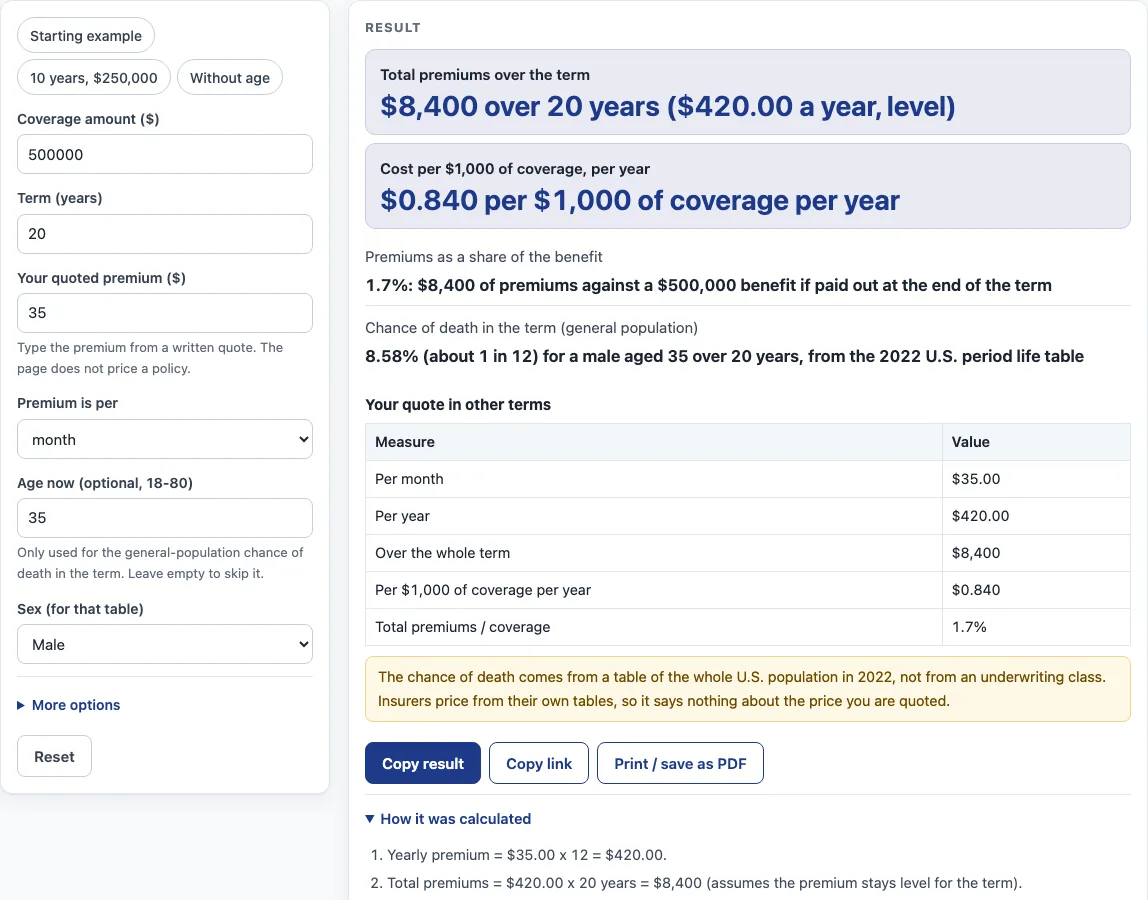
How to use the Term Life Insurance Calculator
- Type the “Coverage amount”, the benefit you want to check the quote against.
- Enter the “Term (years)” in whole years.
- Type “Your quoted premium” from a written quote.
- In “Premium is per”, choose “month” or “year” so it matches how the quote is stated. If you choose “per month”, the page multiplies that premium by 12 to get the yearly premium.
- Optionally, enter an “Age now” from 18 to 80 and choose a sex for the mortality figure. If the last year of the term falls past age 80 (age plus term minus 1 is above 80), the chance of death is not shown and a warning explains why.
- Open “More options” and enter the premium in “Same policy, other payment mode” (the yearly premium if the first one is monthly, or the monthly one if it is yearly). This is what the implied cost of paying monthly is based on.
- Read the results: total premiums over the term, cost per $1,000 of coverage per year, total premiums as a share of the benefit, the chance of death within the term (if you entered an age), and the implied cost of paying monthly (if you entered the other premium).
Ages below 18 or above 80 are rejected, so check the age field if the page does not accept it. The tool runs in your browser and nothing you type is uploaded.
How does the term life insurance calculator work out premium totals and cost per $1,000?
The calculator first turns the quoted premium into a yearly figure. If the premium is entered “per month”, the yearly premium is the monthly premium multiplied by 12. Total premiums over the term are the yearly premium multiplied by the number of years. This assumes the premium stays level for the whole term.
Cost per $1,000 of coverage per year is the yearly premium divided by the coverage in thousands. For example, $420 a year on $500,000 of coverage is $420 divided by 500, which gives $0.840 per $1,000 a year. Total premiums as a share of the benefit compare the total over the term with the coverage amount. In the default example, $8,400 over 20 years on $500,000 is 1.68%, shown as 1.7%.
The implied cost of paying monthly needs a more involved calculation. Let m be the monthly premium and A the yearly premium. The page looks for a monthly rate j where A = m × (1 + v + … + v¹¹), with v = 1/(1 + j) and each payment made at the start of the month. No simple formula solves this for j, so the page uses bisection. Bisection repeatedly narrows a range of rates, keeping the half that brackets the solution, until the two sides of the equation match. The page then reports 12j as the nominal rate and (1 + j)¹² − 1 as the effective rate. If 12 times the monthly premium is not above the yearly premium, it reports no extra cost.
A worked example from the page: a yearly premium of $420 against $37 a month gives 12 × $37 = $444, which is $24.00 more a year. The implied cost is 12.32% nominal and 13.04% effective.
How is the chance of death within the term worked out, and what does it leave out?
The chance of death within the term uses qx values from the CDC/NCHS United States Life Tables, 2022 (NVSR 74(2), Tables 2 and 3), copied for each sex at ages 18 to 80. For each year of age from the age you type through age plus term minus 1, the page takes 1 minus qx. It multiplies those survival chances together and subtracts the product from 1. The result is the chance of dying during the term, from whole-population U.S. death rates.
For a 35-year-old male and a 20-year term, the default chance is 8.58%, about 1 in 12. For a 45-year-old female and a 10-year term, it is 3.32%, about 1 in 30.
This table is a period table of the whole U.S. population, not an underwriting class. Insurers price policies from their own tables, so this figure says nothing about the premium you were quoted. If the last year of the term falls past age 80, the page does not show the chance and displays a warning. This is an estimate only; get quotes from a licensed insurer or agent, and ask a licensed agent or advisor about your own situation.
Sources (checked 15 October 2026): cdc.gov · ssa.gov · westernsouthern.com · insurance.ky.gov
Worked examples
| Input | Result |
|---|---|
| $500,000 for 20 years at $420.00 a year | $8,400 in premiums, $0.840 per $1,000 a year |
| $250,000 for 10 years at $264.00 a year | $2,640 in premiums, $1.056 per $1,000 a year |
| $500,000 for 20 years at $420.00 a year | $8,400 in premiums, $0.840 per $1,000 a year |
| $1,000,000 for 30 years at $360.00 a year | $10,800 in premiums, $0.360 per $1,000 a year |
Calculated by the tool above; open it with the same values to see each step.
How this tool works and where the numbers come from
The calculator does arithmetic on a premium you type in: yearly premium (monthly x 12), total premiums over the term, cost per $1,000 of coverage per year, and the implied cost of paying monthly, found by bisection. If you add an age and sex, the chance of death within the term is 1 minus the product of (1 - qx) over the years of the term, using qx from the US life tables for 2022; it is a whole-population figure, not an underwriting class, and it does not price a policy.
Sources
Frequently asked questions
Is this term life insurance calculator a quote tool?
No. It does arithmetic on a premium you type in. It does not price a policy from your age or health, and the results are estimates, not quotes. It is not a quote and not advice; ask a licensed agent or advisor.
Why does the chance of death differ from the premium I was quoted?
The chance of death uses a period table for the whole U.S. population, not an underwriting class. Insurers price from their own tables, so the two figures are not linked.
What happens if the term runs past age 80?
If age plus term minus 1 is above 80, the page does not show the chance of death within the term, and a warning explains why. Ages below 18 or above 80 are rejected when you enter them.
What does the implied cost of paying monthly mean?
It is the annual rate implied by paying monthly instead of yearly, given the two premiums you typed. For a $37 monthly premium against a $420 yearly premium, the page shows 12.32% nominal and 13.04% effective.
How is cost per $1,000 a year worked out?
Divide the yearly premium by the coverage amount in thousands. A $420 yearly premium on $500,000 of coverage is $0.840 per $1,000 a year.
Is my information uploaded anywhere?
No. Everything runs in your browser, nothing you type is uploaded.
Related tools
- All Life Insurance Calculators: the hub with every life insurance page on this site.
- Life Insurance Cost Calculator: use it when you are looking at the cost of life insurance more generally.
- How Much Life Insurance Do I Need?: use it when you want to work through how much coverage to consider.
- Mortgage Life Insurance Calculator: use it when your question is about life insurance tied to a mortgage.
- Whole Life Insurance Cost Calculator: use it when you are looking at whole life policies rather than term.
- Home and Rental Coverage: worksheets for homeowners, renters and landlords.