Sell Term Life Insurance Policy Calculator
Type the death benefit, your premium, the years until payout and the return a buyer wants to see a price ceiling and the tax on a sale.
A sell term life insurance policy calculator estimates what an in-force term policy could be worth to a buyer and what you would owe in federal tax if you sold it. It works backwards from the buyer: the buyer receives the death benefit in some future year, pays your premiums until then, and wants a yearly return on what it pays. The most it could pay and still earn that return is the price ceiling. Real offers are lower.
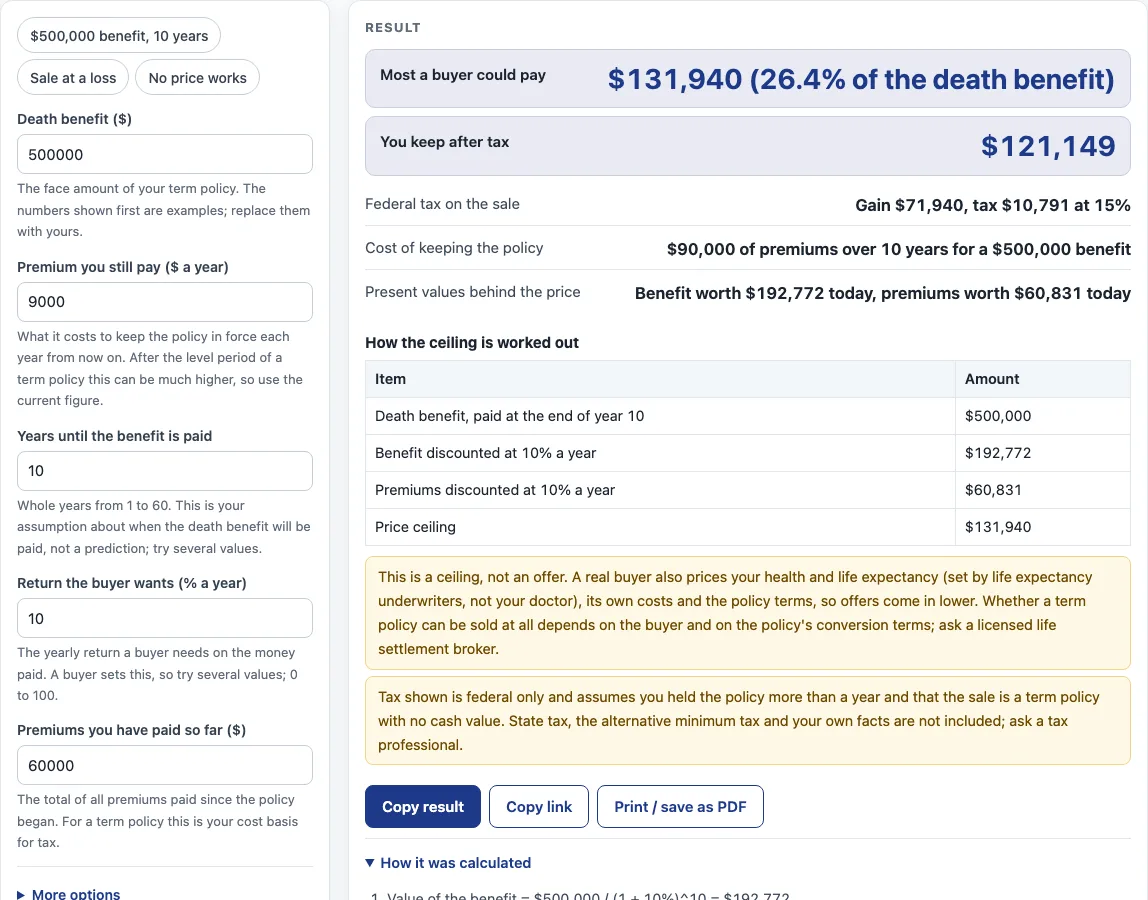
With a $500,000 death benefit, $9,000 a year in premiums, 10 years until payout and a 10% return, the ceiling is $131,940, or 26.4% of the death benefit. After $60,000 of premiums already paid, that is a gain of $71,940 and $10,791 of tax at 15%. The years and the return are assumptions you choose, so try several. The tool runs in your browser and is free. The result is an estimate, not an offer or tax advice.
How to use the sell term life insurance policy calculator
- Type the “Death benefit ($)” of your term policy and the “Premium you still pay ($ a year)”, the amount it costs to keep the policy in force from now on.
- Type “Years until the benefit is paid”. This is your assumption; a buyer’s would come from a life expectancy estimate.
- Type “Return the buyer wants (% a year)”. A higher return lowers the price ceiling, because the buyer discounts the benefit more.
- Type “Premiums you have paid so far ($)”. For a term policy this is your cost basis for tax.
- Read “Most a buyer could pay”, then “You keep after tax”. Open “More options” to set your federal long-term capital gains rate (0%, 15% or 20%) and a broker commission, which comes off the price before tax.
- Read “Cost of keeping the policy” to see the premiums you would pay over the same years for the benefit, and “Present values behind the price” for the two numbers that make up the ceiling.
If the premiums are worth more than the benefit at your numbers, the tool says no price works instead of showing a negative offer. Try the example chips for a sale at a loss and for a case where no price works. Everything updates as you type, and the address bar keeps your settings.
How is the price ceiling worked out?
The benefit is paid at the end of year n, so it is worth the death benefit divided by (1 + r) to the power n today. The premiums are paid at the start of each of the n years, so their value is the annual premium times (1 - (1 + r)^-n) / r times (1 + r). The ceiling is the first number minus the second. With a $500,000 benefit, 10 years and 10%, the benefit is worth $192,772 today and the premiums $60,831, which leaves $131,940.
What does the SEC say about selling a life insurance policy?
The SEC’s investor bulletin on life settlements describes a sale in which a policy owner sells the policy to an investor for a lump sum. It says the payment is generally less than the death benefit but more than the cash surrender value, that life expectancy underwriters (not the insured’s own doctor) evaluate the risk of mortality, and that brokers who charge commissions may be involved. Most term policies build no cash value, so there is usually no surrender value to compare an offer with.
How is the sale taxed?
The IRS treated the sale of a term contract with no cash value as a long-term capital gain or loss in Revenue Ruling 2009-13. Revenue Ruling 2020-5 later said the cost basis of a life insurance contract is not reduced by the cost of insurance, so your basis is the premiums you paid. Gain is the amount you receive minus those premiums. In the IRS’s own term example, premiums of $45,000 and a $20,000 sale price gave a $25,000 long-term capital loss, which cannot be deducted unless it is incurred under section 165(c)(1) or (2) of the Internal Revenue Code. The calculator applies the federal rate you type to a gain and shows no tax on a loss. It does not include state tax or any other rule.
Why is the result only a ceiling?
It uses one assumed payout year and one return. A buyer also prices your health and life expectancy, the cost of managing the policy, the policy terms and its own profit, so offers come in lower. Whether a term policy can be sold at all depends on the buyer and on the policy’s conversion terms, which are in your contract. Ask a licensed life settlement broker.
What if I keep the policy?
Keeping it means paying the premiums and leaving the death benefit to your beneficiaries. The tool shows the cost of keeping the policy (premium times years) next to the benefit so you can see the trade, but it does not tell you which is better. That depends on your needs, your health, who relies on the benefit and what the premiums become.
Sources (checked 23 October 2026): SEC, Investor Bulletin on Life Settlements; IRS, Revenue Ruling 2009-13 (IRB 2009-21); IRS, Revenue Ruling 2020-5 (IRB 2020-9)
Worked examples
| Input | Result |
|---|---|
| $500,000 benefit, 10 years, 10% return | price ceiling $131,940 |
| $250,000 benefit, 12 years, 12% return | price ceiling $22,543 |
| $100,000 benefit, 15 years, 15% return | no price works |
Calculated by the tool above; open it with the same values to see each step.
Frequently asked questions
Can I sell my term life insurance policy?
Sometimes. A sale to an investor is called a life settlement, and whether a buyer will take a term policy depends on the buyer, your health and the policy’s conversion terms. This calculator estimates a ceiling; it cannot tell you whether anyone will buy.
How much can I get for a term life insurance policy?
The calculator shows the most a buyer could pay at the return you type. The SEC says a life settlement payment is generally less than the death benefit, and a term policy has no cash surrender value to compare with.
Is the money from selling a term policy taxable?
Under IRS Revenue Rulings 2009-13 and 2020-5, a sale of a term policy gives a long-term capital gain or loss equal to what you receive minus the premiums you paid. A gain is taxed; a loss is not deductible in most cases. State tax and your own facts can change this, so ask a tax professional.
What return should I assume a buyer wants?
There is no published figure in the sources on this page, so the tool starts at 10% as an example and lets you try others. A higher return gives a lower ceiling.
What if the calculator says no price works?
It means the premiums are worth more than the benefit at your years and return. Try fewer years or a lower return; if no price works, a buyer would lose money at those assumptions.
Does the tool share my numbers?
No. It does arithmetic in your browser, asks for no contact details and does not send your policy to buyers or brokers.
Other life insurance calculators on this site:
- Personal insurance calculators - the full list.
- Term life insurance calculator - totals and cost per $1,000 for a term quote.
- Whole life insurance calculator - cash value and implied return from an illustration.
- Life insurance cost calculator - scale and compare quotes.
- Mortgage life insurance calculator - cover a loan balance.