Subcontractor Insurance Requirements Letter Generator
Choose the coverages, limits and endorsements you want from a subcontractor or vendor. The page writes a requirements letter or exhibit you can print, save as PDF or copy.
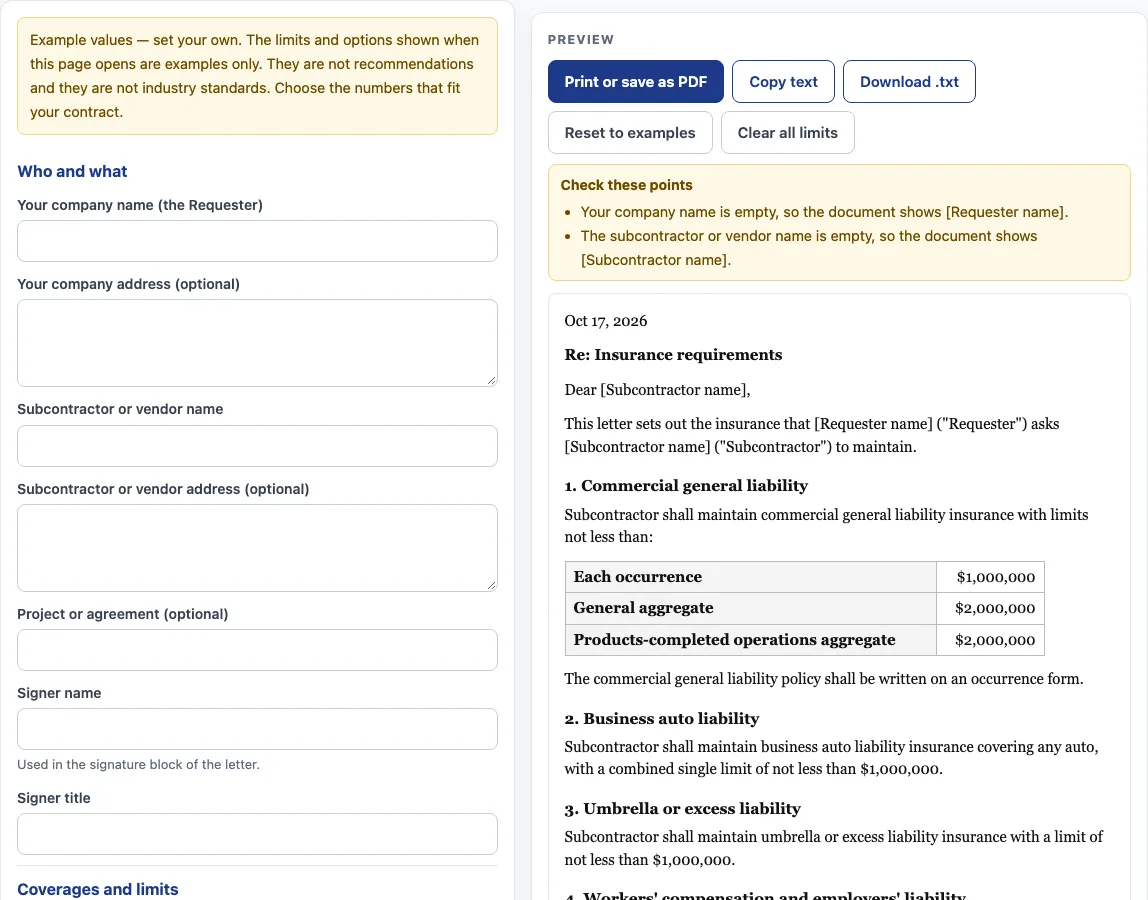
How to use the subcontractor insurance requirements letter generator
- Under “Who and what”, type your company name in “Your company name (the Requester)” and the subcontractor or vendor name in “Subcontractor or vendor name”. Add a project or agreement name if you want it in the intro.
- Under “Coverages and limits”, tick each coverage you want and type its limits in dollars. A limit left empty leaves that line out of the document.
- Under “Endorsements”, tick the additional insured, “Primary and noncontributory” or waiver of subrogation lines you want. Then choose the wording in “Additional insured wording”.
- Under “Evidence and extras”, tick “Ask for a certificate of insurance” and “Ask for copies of the endorsements”, then choose when the evidence is due under “Deliver the evidence”.
- Under “Style”, choose “Letter” or “Contract exhibit (Exhibit: Insurance Requirements)”.
- Read the points under “Check these points” above the preview. Then click “Print or save as PDF”, “Copy text” or “Download .txt”.
The form opens with example values, and a banner above it says so. Replace them with your numbers, use “Reset to examples” to return to the examples, or use “Clear all limits” to empty the dollar fields. The document is a list of requests to the subcontractor. It does not change any policy. Check the wording with your attorney or insurance advisor before you send it.
What insurance should a subcontractor carry?
This page does not set a standard. The figures it opens with are examples, and you set your own limits and coverages to fit the contract, with advice from your insurance advisor or attorney. State law varies. A certificate of insurance is evidence that certain types of coverage and limits have been bought, issued on behalf of the party that has to show it carries insurance.
What goes in a subcontractor insurance requirements letter?
The letter names both parties, the project, each coverage with its limits, the endorsements, and the evidence you want back. This generator writes those as numbered sections in a fixed order, from commercial general liability through evidence of insurance and other terms. Endorsements carry most of the detail. An additional insured is a person or organization that is not automatically an insured under the policy but is added at the named insured’s request, often a project owner or customer. Its rights depend on the endorsement wording. Two ISO forms are often named as examples: CG 20 10 for ongoing operations and CG 20 37 for completed operations. A secondary listing describes each as limited to liability caused in whole or in part by the named insured’s acts or omissions, so check the edition on your own policy. A waiver of subrogation is an insurer’s acknowledgment that it has no right to subrogate against a liable third party. A pre-loss waiver generally does not bar coverage, but many policies exclude coverage when subrogation is waived after a loss.
Why ask for endorsement copies as well as a certificate?
A certificate is evidence of insurance, not a policy. It does not amend, extend or alter the coverage of the policy it refers to, and it gives no rights beyond what the policy expressly provides. A certificate also cannot warrant that the policy meets the contract, and a contract number written on it does not change that. The endorsement is the document that sets the additional insured, primary or waiver terms, so ask for copies. One city’s checklist asks for the policy number printed on each endorsement. For primary and noncontributory wording, the text of ISO form CG 20 01 says the insurance is primary and will not seek contribution from other insurance available to the additional insured, but only when that party is a named insured on the other policy and the contract says so in writing. Notice of cancellation works the same way: a person gets it only if the policy or an endorsement gives that right. Contracts often ask for written notice, typically at least 30 days, according to one law firm.
Sources (checked 16 October 2026): NCOIL Certificates of Insurance Model Act · IRMI: certificate of insurance · IRMI: additional insured · IRMI: waiver of subrogation · ISO CG 20 01 text · Taft Law checklist · City of San Diego insurance checklist · Jones CG 20 10 listing, secondary · Jones CG 20 37 listing, secondary
Frequently asked questions
What is the difference between a letter and an exhibit?
A letter has a date, a salutation, numbered sections and a signature block, and it reads as a message to the subcontractor. An exhibit has a title, a date and lettered sections, with no salutation or signature, so it can sit inside a contract or agreement.
Is my company or subcontractor information uploaded?
No. Everything runs in your browser, and nothing is uploaded or saved by the page.
Does this page tell me what limits to set?
No. The limits shown when the page opens are examples only. They are not recommendations and they are not industry standards. Choose the numbers that fit your contract, and check them with your insurance advisor or attorney.
Is this legal or insurance advice?
No. The document is a template of requests. Have your attorney or insurance advisor review it before you send it.
Why does the document ask for endorsement copies?
A certificate does not change the policy it refers to. The endorsement is the document that carries the additional insured, primary or waiver wording, so the document asks for a copy of each one next to the certificate.
Can I paste this text into a contract?
You can copy it, and the “Contract exhibit” style is written for that. It is a template of requests, not reviewed legal wording, so have your attorney or insurance advisor review it before it goes into a contract.
Related pages on this site:
- Certificates of insurance - the hub for this site’s tools, when you want the overview first.
- ACORD 25 checker - when a certificate comes back and you want to check its boxes.
- How to read a certificate of insurance - to learn what each box says.
- Additional insured endorsement - why the endorsement, not the certificate, gives the terms.
- Waiver of subrogation - the basics before you ask for a waiver.
- Primary and noncontributory - when your letter asks for primary wording.
- Certificate of insurance sample - a made-up certificate explained part by part.
- Certificate holder vs additional insured - why being named on a certificate is not the same as being insured under the policy.