Index Universal Life Insurance Calculator
Type yearly index changes and your contract's cap, participation rate, floor and charges to see the credited rate and account value for each year.
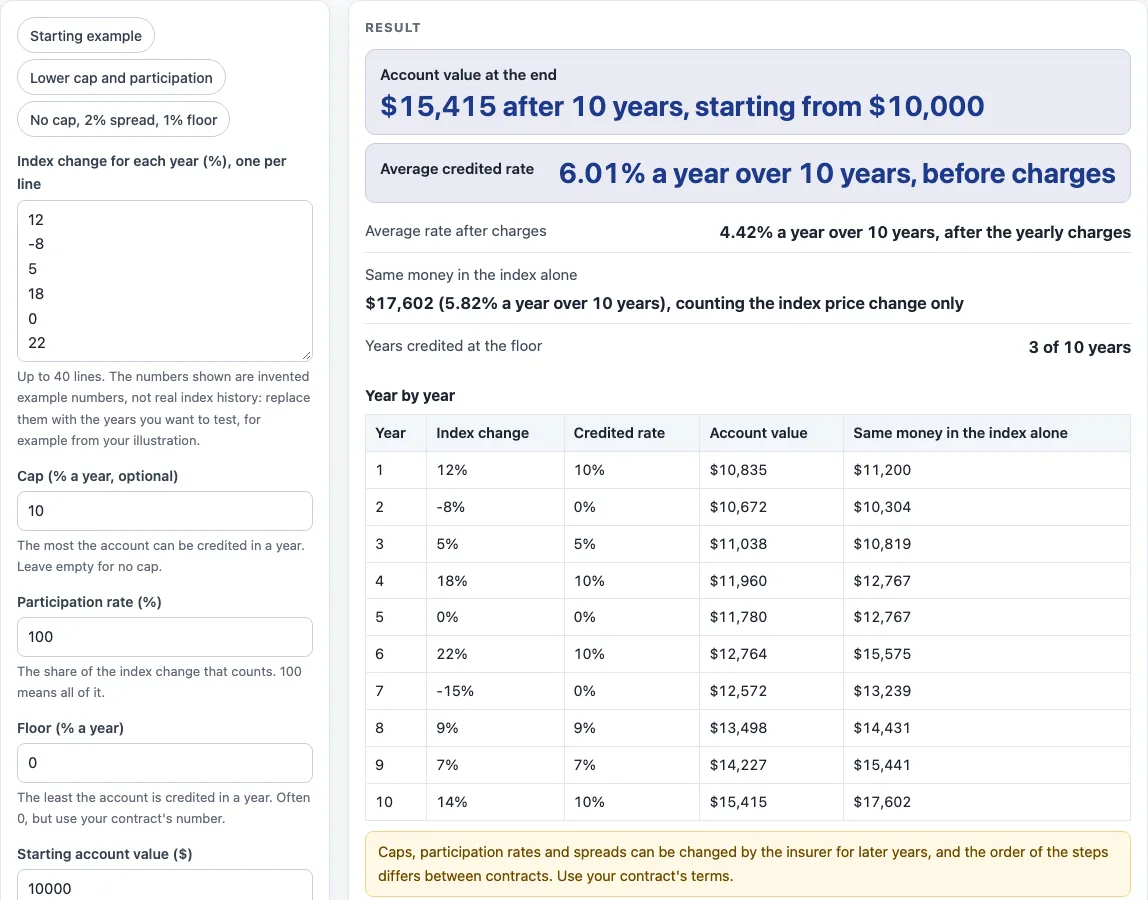
How to use the index universal life insurance calculator
- In “Index change for each year (%), one per line”, type the yearly index changes you want to test, up to 40 lines. Use negative numbers for down years.
- Enter the “Cap (% a year, optional)”, the “Participation rate (%)” and the “Floor (% a year)” from your contract. Leave the cap empty if there is none.
- Type the “Starting account value ($)” and the “Yearly charges (% of account value)”.
- Open “More options” to add a “Spread or margin (%, optional)” if your contract has one.
- Read “Account value at the end”, “Average credited rate”, “Average rate after charges” and “Same money in the index alone”.
- Scroll to the table to see each year’s index change, credited rate, account value and the index-alone value. “Years credited at the floor” counts the years with no growth from the index.
- Try the chips “Lower cap and participation” and “No cap, 2% spread, 1% floor”.
Everything updates as you type, and the address bar keeps your settings, so you can copy the link or print the result. To test your own scenarios, replace the example lines with yearly changes of your choice: a run of flat or falling years shows how the floor and the yearly charges interact, and a run of strong years shows how the cap limits the credit. Run it with different caps and participation rates from your illustration to see how much each term matters. The steps under the result show how the first year was credited.
How is the credited rate worked out?
The NAIC’s Actuarial Guideline XLIX describes an index account as one where the credited rate is tied to an external index. For illustrations it defines a benchmark account in which interest is based on the percent change in the S&P 500 over one year using only the beginning and ending values, an annual cap is used, the floor is 0%, the participation rate is 100% and interest is credited once per year.
This page uses the same ingredients with your numbers: credited rate = participation rate x index change, minus any spread, then at least the floor and at most the cap. For example, with an 80% participation rate and a 10% cap, a 12% index year credits 9.6%, an 8% fall credits 0% and a 25% rise credits 10%. The order of the steps differs between contracts, so your contract decides.
What does the default example show?
With the invented index changes 12, -8, 5, 18, 0, 22, -15, 9, 7 and 14, a 10% cap, 100% participation, a 0% floor, $10,000 to start and 1.5% yearly charges, the account is worth $15,415 after 10 years. Three of the ten years are credited at 0%. The average credited rate is 6.01% a year before charges and 4.42% after. The same $10,000 in the index price change alone grows to $17,602, or 5.82% a year. Before charges the capped account would have reached $17,930, a little more than the index alone, because the floor skipped the down years; after the 1.5% yearly charges it ends at $15,415. A different sequence gives a different result, so test several.
Does a floor protect the account from charges?
No. The floor sets the lowest credited rate. The yearly charge is taken afterwards. With a 0% credit and a 1.5% charge, $1,000 becomes $985. That is why the page shows the average rate after charges, not only before.
What do the other example chips show?
“Lower cap and participation” uses an 8% cap, an 80% participation rate and no charges on the same ten years. The account reaches $16,017, an average credited rate of 4.82% a year, against $17,602 for the index alone. “No cap, 2% spread, 1% floor” uses five invented years (4, 6, -2, 9 and 11), a 1% yearly charge and no cap. The account reaches $11,883, with an average credited rate of 4.56% before charges and 3.51% after, against $13,071 for the index alone.
Sources (checked 19 October 2026): lifeinsuranceconsumeradvocacycenter.org
Worked examples
| Input | Result |
|---|---|
| 10 years, cap 10% | account value $15,415, 4.42% a year after charges |
| 10 years, cap 8% | account value $16,017, 4.82% a year after charges |
| 5 years, cap no cap | account value $11,883, 3.51% a year after charges |
Calculated by the tool above; open it with the same values to see each step.
Frequently asked questions
Is the index change here real S&P 500 history?
No. The numbers shown are invented examples. Replace them with the years you want to test. The page does not hold index data.
Does the index-alone figure include dividends?
No. It multiplies the yearly changes you typed, which stands for price change only, with no cap, floor or charge.
Can the insurer change the cap?
Contracts can allow changes to caps, participation rates or spreads for later years. This page keeps your numbers fixed, so check your contract for what can change.
Is this an index universal life quote?
No. It does arithmetic on the terms you type and does not price a policy. Results are estimates only.
Is anything I type uploaded?
No. The calculation runs in your browser.
What is the participation rate?
It is the share of the index change that counts. At 80%, a 10% index year counts as 8% before the cap, the floor and any spread are applied.
Why is the account value lower than the credited-rate average suggests?
The yearly charge comes out after the credit. In the default example the average credited rate is 6.01% a year, but after the 1.5% charges the account grows 4.42% a year.
Other life insurance calculators on this site:
- Universal life insurance calculator - the monthly charges and lapse side of a universal life policy.
- Personal insurance calculators - the full list.
- Whole life insurance calculator - cash value and implied return.
- Life insurance cost calculator - scale and compare quotes.
- Term life insurance calculator - totals for a term quote.