How Much Homeowners Insurance Do I Need?
Enter your living area and your rebuild cost per square foot to see the dwelling figure, the other coverage lines as published percentages, and what the 80% rule pays on a partial loss.
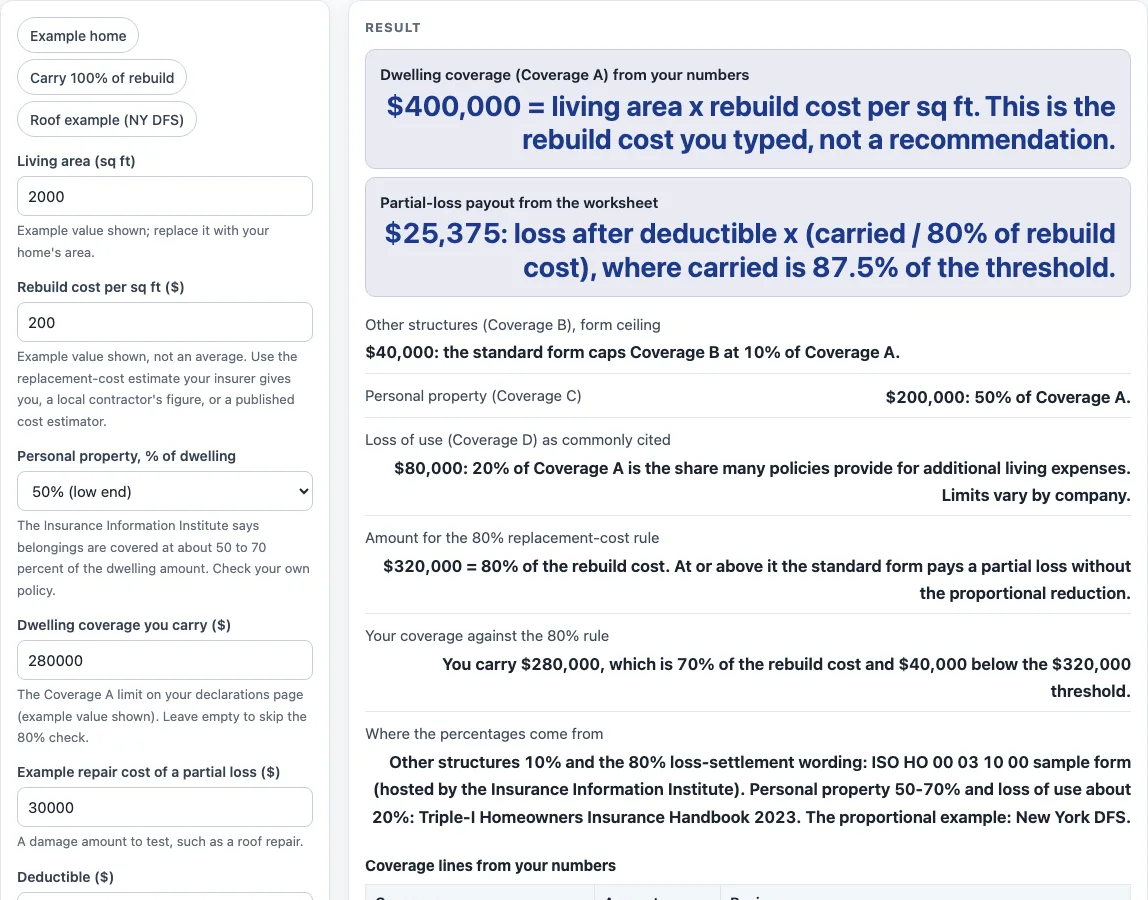
How to use the homeowners insurance worksheet
- Optionally choose a preset: “Example home”, “Carry 100% of rebuild” or “Roof example (NY DFS)”. A preset fills in the form so you can see how the numbers work.
- Enter your “Living area (sq ft)”. The example uses 2,000, which you should replace with your own figure.
- Enter the “Rebuild cost per sq ft ($)”. The page does not supply one, so use a figure from your own source. The example uses $200.
- Select “Personal property, % of dwelling”: 50%, 60% or 70%. The default is 50%.
- Optionally type an “Inflation guard (% per year, optional)”. Leave it empty to skip it.
- Read Coverage A, the dwelling figure. Coverage B is shown at 10% of it and Coverage D at 20%. Coverage C follows your personal property selection.
- Enter “Dwelling coverage you carry ($)”, the “Example repair cost of a partial loss ($)”, the “Deductible ($)” and, optionally, the “Actual cash value of the damaged part”.
- Read the payout. It is capped at the amount carried and is never below zero.
- Check the warnings. They appear when the coverage typed is above the rebuild cost, when the loss is above the amount carried, and when the deductible is at least the loss.
- Use the table to see the same loss at 50%, 60%, 70%, 80%, 90% and 100% of the rebuild cost carried, with the paid amount and the part left unpaid after the deductible.
Presets only fill in values, so you can change any number and test your own case.
How much homeowners insurance do I need?
This page does not say what amount to carry, and it gives no premium or quote. It shows arithmetic on your own numbers and published percentages, so every result is an estimate only.
The worksheet starts with Coverage A, the dwelling figure. It is living area in square feet multiplied by the rebuild cost per square foot you enter. The example of 2,000 sq ft at $200 per sq ft gives $400,000. Those values are placeholders to replace, not averages.
The other limits are percentages of Coverage A. Other structures (Coverage B) is shown at 10% of Coverage A, following the ISO HO 00 03 sample form, which says the limit will not be more than 10% of the Coverage A limit. Personal property (Coverage C) is 50%, 60% or 70% of Coverage A. Triple-I gives 50 to 70 percent for most policies, and some sources quote a flat 50 percent, so the page offers all three. Loss of use (Coverage D) is 20% of Coverage A, based on the Triple-I Homeowners Insurance Handbook (2023), which notes that many policies provide about 20 percent for additional living expense. Limits vary by company. The optional inflation guard is applied once: dwelling x (1 + percent).
How much dwelling coverage do I need?
The dwelling figure is only as accurate as the rebuild cost per square foot you enter. The 80% rule threshold is 80% of the rebuild cost, which is $320,000 in the example. Under the standard form, if the amount carried is 80% or more of replacement cost, a partial loss pays the repair cost after the deductible, up to the limit.
Below 80%, the form pays the greater of two amounts: the actual cash value of the damaged part, or the proportion of the repair cost, after the deductible, that the amount carried bears to 80% of replacement cost. The worksheet uses this formula:
payout = (loss - deductible) x carried / (80% x rebuild cost)
The deductible is subtracted before the proportion, as the form wording orders it. Many consumer guides apply the deductible after the proportion, which gives different results. This page follows the form and says so.
Worked example 1 (defaults): Rebuild cost $400,000, carried $280,000 (70%), loss $30,000, deductible $1,000. The required amount is $320,000, the ratio is 87.5%, and the payout is $25,375.
Worked example 2 (New York DFS roof example): Rebuild cost $100,000, carried $50,000, repair $5,000, no deductible, actual cash value $2,000. The calculation is $50,000 x $5,000 / $80,000 = $3,125. That is more than $2,000, so $3,125 is paid.
Sources (checked 15 October 2026): iii.org · dfs.ny.gov · iii.org · iii.org
Worked examples
| Input | Result |
|---|---|
| 2000 sq ft at $200 per sq ft; carrying $280,000 | $25,375: loss after deductible x (carried / 80% of rebuild cost), where carried is 87.5% of the threshold. |
| 2000 sq ft at $200 per sq ft; carrying $320,000 | $29,000: loss $30,000 minus the $1,000 deductible, within your limit (no proportional reduction at 80% or more). |
| 1500 sq ft at $250 per sq ft; carrying $200,000 | $3,333: loss after deductible x (carried / 80% of rebuild cost), where carried is 66.7% of the threshold. |
| 2000 sq ft at $200 per sq ft; | $400,000 = living area x rebuild cost per sq ft. This is the rebuild cost you typed, not a recommendation. |
Calculated by the tool above; open it with the same values to see each step.
Frequently asked questions
Frequently asked questions
Does this tool tell me how much homeowners insurance to buy?
No. It multiplies your numbers and applies published percentages to produce an estimate. It does not recommend a coverage amount or a limit. Every result is an estimate only; get quotes from a licensed insurer or agent.
Where do the example numbers come from?
The example home uses 2,000 sq ft at $200 per sq ft, which gives $400,000. These are placeholders to replace with your own figures, not averages.
Why is the deductible subtracted before the proportion?
The ISO HO 00 03 form wording orders it that way: (loss - deductible) x carried / (80% x rebuild cost). Many consumer guides apply the deductible after the proportion, so their results can differ. This page follows the form.
What is the inflation guard percent?
It is an optional percent that you type, and it is applied once as dwelling x (1 + percent). The page does not supply a percent. For example, 4% on $375,000 gives $390,000.
Why are there 50%, 60% and 70% options for personal property?
Triple-I gives 50 to 70 percent for most policies, while some sources quote a flat 50 percent. The default is 50%, and the page offers all three options.
What happens when the payout reaches a limit?
The payout is capped at the amount carried and is never below zero. Warnings also appear when the loss is above the amount carried, or when the deductible is at least the loss.
Related tools
- Home and Rental Coverage The hub with every home and rental page on this site.
- How Much Renters Insurance Do I Need? Use it if you rent your home rather than own it.
- Umbrella Insurance Calculator Use it if you want to look at liability coverage above your home policy limits.
- Life Insurance Calculators The hub with every life insurance page on this site.
- How Much Life Insurance Do I Need? Use it for a worksheet on life insurance amounts.
- Business Insurance Costs The hub for small business insurance cost pages.