Certificate of Liability Insurance
Look up any term on a certificate of liability insurance and read what it shows, what it cannot prove and what to ask the agent for next.
How to use the certificate of liability insurance glossary
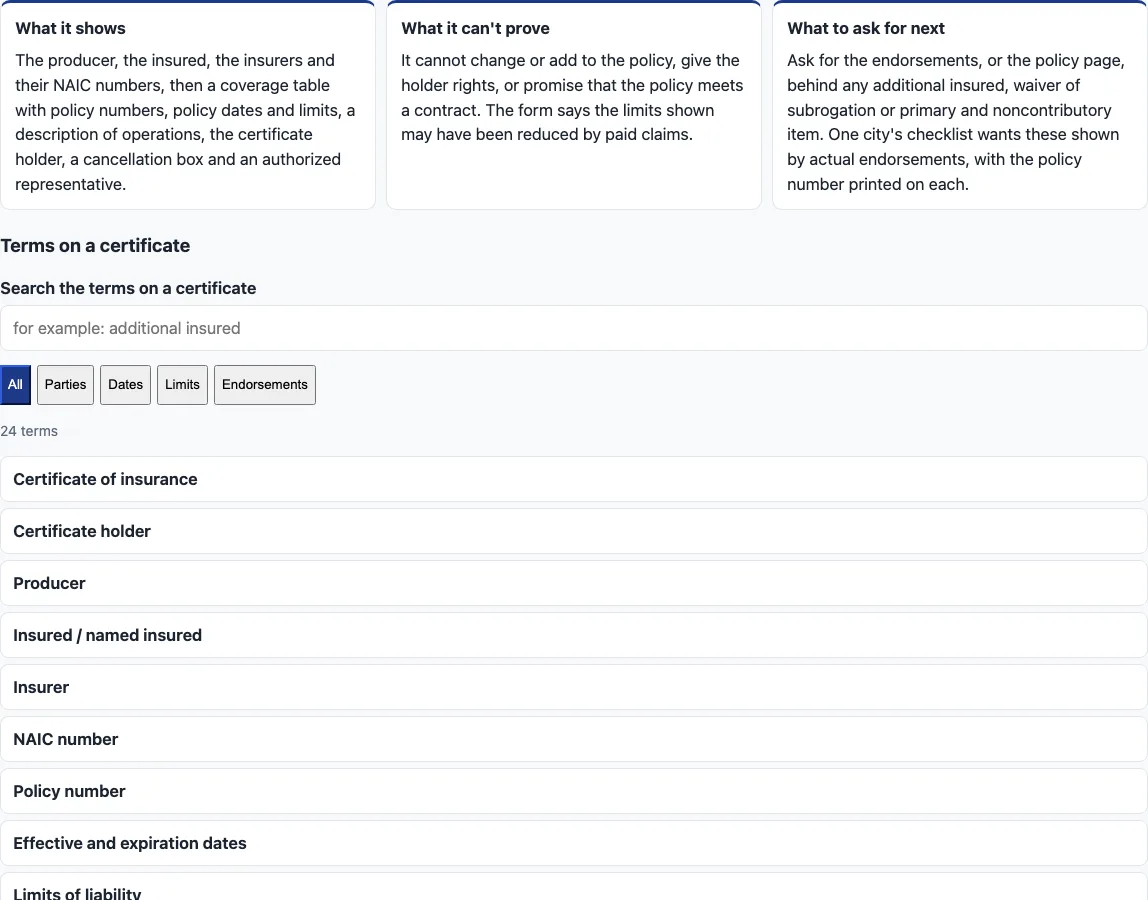
- Type a term from your certificate into the box labelled “Search the terms on a certificate”. Try “additional insured” or “limits”. Press Esc or choose “Clear search” to start again.
- Choose a quick filter: “All”, “Parties”, “Dates”, “Limits” or “Endorsements”. The line under the filters shows how many terms match.
- Select a term to open its explanation. Where a term has a caution, read the “Worth knowing” note.
- Read the three cards, “What it shows”, “What it can’t prove” and “What to ask for next”, if you want the overview first.
- Choose “Check your own certificate in your browser” or “More certificate of insurance tools” at the bottom when you are ready for the next step.
The glossary explains terms in general. It does not read your certificate, and it cannot tell you whether your policies meet a contract. Limits shown on a certificate may have been reduced by paid claims, and state law varies. Each term explains what the form says and what a reader can check, but not what your own policy covers. Ask the agency about anything unclear, and read the endorsements before you rely on the certificate.
What is a certificate of liability insurance?
A certificate of liability insurance is a certificate of insurance that sets out the liability coverages on a policy. A certificate of insurance is a document that gives evidence that certain general types of insurance coverages and limits have been purchased, and it is issued on behalf of the party that has to show it carries insurance. The standard ACORD 25 form sets this out in boxes and a coverage table.
The certificate is not the policy. The NCOIL model act, which is a model for state legislatures and not law everywhere, says a certificate does not amend, extend or alter the coverage of the policy it refers to. It also says a certificate gives no one new rights beyond what the policy expressly provides. The form itself says it is issued as a matter of information only.
What does a certificate of liability insurance show?
It shows the producer, the insured, the insurers with their NAIC numbers, a coverage table, a description of operations, the certificate holder, a cancellation box and an authorized representative’s signature. The coverage table has a row for commercial general liability, automobile liability, umbrella or excess liability, and workers compensation with employers’ liability. Each row names an insurer by letter and gives a policy number, policy dates and limits.
Two more columns, ADDL INSD and SUBR WVD, carry marks that state additional insured status or a waiver of subrogation for that row.
One city’s checklist, the City of San Diego’s, asks for the contracting party’s full name as insured, current policies, limits that reflect the contract, the occurrence box marked for general liability, and the subrogation box marked for workers compensation. That is one city’s list, not a universal rule. These checks cover the certificate. They do not cover the policy wording.
What can’t a certificate of liability insurance prove?
It cannot prove that the policy meets a contract. A certificate may not warrant that the policy meets a contract’s insurance or indemnification requirements, and naming a contract number or description on it does not change that. It also cannot change the notice terms. A person gets notice of cancellation, nonrenewal or material change only if the policy or an endorsement gives that right. The form adds that limits shown may have been reduced by paid claims, and that the coverage is subject to all the policy’s terms, exclusions and conditions.
Additional insured status needs more than a certificate. An additional insured is a person or organization that is not automatically an insured, but is included or added at the named insured’s request. Their rights depend entirely on the terms of the specific endorsement, and an endorsement can limit cover, for example by excluding claims that arise after the work is completed. Being the certificate holder does not do this either.
What should I ask for after receiving one?
Ask for the endorsement, or the policy page, behind each additional insured, waiver of subrogation or primary and noncontributory item your contract needs. One city’s checklist wants these shown by actual endorsements, separate from the certificate, with the policy number printed on each. Read the endorsement terms before you sign anything.
For primary and noncontributory wording, the ISO form CG 20 01 04 13 says the insurance is primary to, and will not seek contribution from, other insurance available to an additional insured. Its conditions include that the additional insured is a named insured on that other insurance, and that the contract asked in writing for primary coverage. For a waiver of subrogation, ask when the waiver was given. A waiver before a loss generally does not bar coverage, but many policies exclude coverage if subrogation is waived after a loss. Ask what the policy itself provides on cancellation notice, because the certificate cannot change it.
Sources (checked 16 October 2026): IRMI glossary: certificate of insurance · NCOIL model act · ACORD 25 printed text · IRMI glossary: additional insured · Taft Law checklist · IRMI glossary: waiver of subrogation · ISO CG 20 01 copy · City of San Diego checklist
Frequently asked questions
What is a certificate of liability insurance?
A certificate of liability insurance is a document that gives evidence of the liability coverages on a policy, with their limits and dates. It is issued for the party that has to show it carries insurance. It is not the policy.
What does a certificate of liability insurance show?
It shows the producer, the insured, the insurers and their NAIC numbers, a coverage table with policy numbers, dates and limits, the description of operations, the certificate holder, the cancellation box and the authorized representative’s signature.
What can’t a certificate of liability insurance prove?
It cannot prove that the policy meets a contract, change the policy, or give the holder rights. The form also says the limits shown may have been reduced by paid claims.
What should I ask for after receiving one?
Ask for the endorsement, or the policy page, behind each additional insured, waiver of subrogation or primary and noncontributory item your contract needs. Read the endorsement terms before you sign anything.
Is my certificate uploaded or checked by this tool?
No. The glossary runs in your browser, and nothing you search or select is stored or sent. It explains terms, but it does not read your certificate.
What does ADDL INSD mean on a certificate?
ADDL INSD is a column in the coverage table. A mark in it is a statement on the certificate that additional insured status applies to that row. The form says a statement on the certificate does not give rights in place of the endorsement, so ask for the endorsement.
Related pages on this site:
- Certificates of insurance - the hub for this site’s certificate tools.
- ACORD 25 checker - look up the terms on your own certificate in the browser.
- How to read a certificate of insurance - a review checklist to work through with a certificate in hand.
- Certificate holder vs additional insured - when holder and additional insured look alike.
- Additional insured endorsement - when an ADDL INSD mark needs the endorsement behind it.
- Waiver of subrogation - when a contract asks about the SUBR WVD column.
- Primary and noncontributory - when a contract asks for primary wording.
- Insurance requirements letter generator - write down the coverage you ask a subcontractor or vendor to carry.
- Certificate of insurance sample - a made-up certificate explained part by part.