Certificate of Insurance Sample
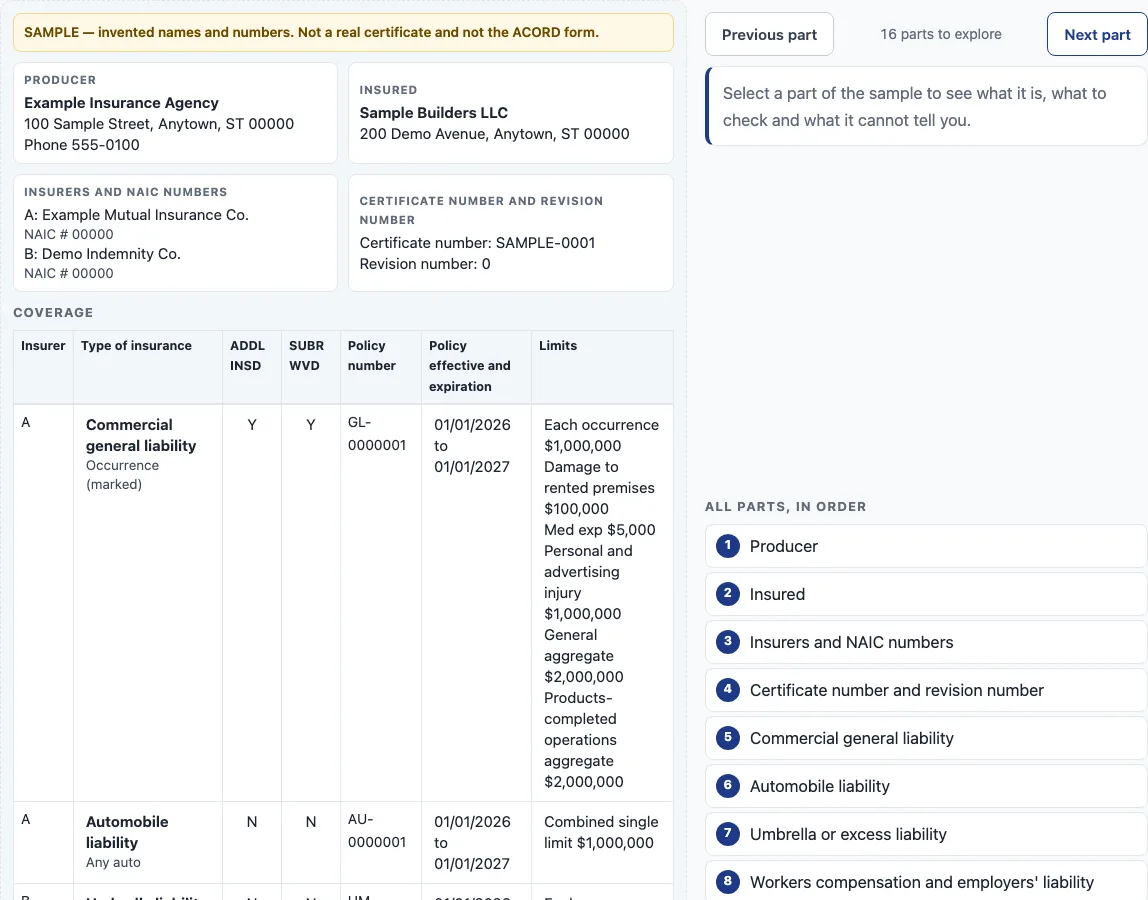
Click any part of this sample certificate to see what it means and what to check. The people, companies and numbers are invented for the example.
How to use the sample
- Read the label above the sample. It says the names and numbers are invented and that the sample is not a real certificate and not the ACORD form.
- Click any part of the sample, such as the producer box, the insured box or a cell in the coverage table. The explanation panel opens with three headings: “What it is”, “Check this” and “What it cannot tell you”.
- Read “Check this” first, then read “What it cannot tell you” before you decide anything about a real certificate.
- Click “Next part” to move down the sample, or “Previous part” to go back. The counter shows where you are, for example “Part 3 of 16”.
- Open “All parts, in order” to jump straight to any numbered part.
- Press Esc to clear the selection and start again.
- When you have a real certificate to check, follow the button “Check your own certificate in your browser”.
The sample only explains the layout, so nothing you do on this page changes or checks a real document. It cannot tell you whether a real certificate meets your contract, because that depends on the contract and on the policies and endorsements behind the certificate. Use the parts as a list of questions to ask your agent.
Is there a sample certificate of insurance?
Yes. This page has one, drawn in its own layout with invented names, addresses, policy numbers and limits. It shows the kinds of boxes the standard ACORD 25 form prints: the producer, the insured, insurers A to F with their NAIC numbers, a coverage table, a description box, the certificate holder, a cancellation box and an authorized representative. The sample is a learning aid. It is not a copy of that form.
What does each part of a certificate of insurance mean?
A certificate of insurance is evidence of coverage, not the coverage itself. The standard form says it is issued as a matter of information only and does not amend, extend or alter the policies it lists. A model act from NCOIL says the same: a certificate is not a policy and gives nobody rights beyond what the policy provides. State law varies, and the model act is not law in every state.
Each coverage row shows the type of insurance, an ADDL INSD mark, a SUBR WVD mark, the policy number, the policy dates and the limits. The marks are statements printed on the certificate, not the endorsements themselves. The form also says the limits shown may have been reduced by paid claims, so a figure on the page is not a statement of what remains. The sample lists an invented $1,000,000 each occurrence limit to show where a limit sits.
What should I check on a certificate before accepting it?
Start with the parties and the dates. Check that the insured name matches the contracting party, that the policy dates cover the work, that the limits reflect your contract, and that the certificate holder box and the authorized representative’s signature are in place. One city’s checklist, the City of San Diego’s, asks for these items and asks that the occurrence box be marked for general liability. That list is one city’s checklist, not a universal rule.
Then check the endorsements. An additional insured’s rights depend entirely on the terms of the specific endorsement, and endorsements can narrow them. Ask for the endorsement, or the policy page that provides the coverage, with the policy number printed on it. The same city asks for these items separately from the certificate. Ask to read the endorsement before signing a contract that depends on it.
Sources (checked 16 October 2026): IRMI glossary · NCOIL model act · ACORD 25 form text, hosted by NPS · Taft Law bulletin · City of San Diego checklist
Frequently asked questions
Is the sample a real certificate?
No. The names, addresses, numbers and limits are invented, and the layout is our own. It is not the ACORD 25 form.
Is this the ACORD 25 form?
No. ACORD is a trademark of ACORD Corporation. This site does not provide, host or copy the form, and the sample only mirrors the kinds of boxes it prints.
What does each part of a certificate of insurance mean?
The viewer explains 16 parts. For each one it gives what it is, what to check and what it cannot tell you. Most parts show what a certificate says, while the policy and its endorsements hold the actual terms.
What should I check on a certificate before accepting it?
Compare the insured name, policy dates, limits, holder box and signature with your contract. For additional insured, waiver of subrogation or primary and noncontributory items, ask for the endorsement or policy page that provides the coverage.
Does the viewer store or send what I click?
No. Nothing you select is stored or sent. The viewer shows the sample and its explanations only.
Does the certificate show the endorsements themselves?
No. The additional insured and waiver of subrogation marks on a certificate are statements, and the form says they do not replace the endorsements. Ask for the endorsement, or the policy page that provides the coverage, when your contract depends on it.
Related pages on this site:
- Certificates of insurance - the hub for all the certificate tools.
- ACORD 25 checker - check your own certificate in your browser.
- How to read a certificate of insurance - a checklist for a real certificate.
- Certificate holder vs additional insured - why the two roles differ.
- Additional insured endorsement - where the additional insured terms sit.
- Waiver of subrogation - what the SUBR WVD column refers to.
- Primary and noncontributory - the wording behind primary coverage.
- Insurance requirements letter generator - write down the coverage you ask a subcontractor or vendor to carry.