Certificate Holder vs Additional Insured
Paste the insurance paragraph from your contract to see whether it asks for a certificate holder, additional insured status, or both, and what each one means.
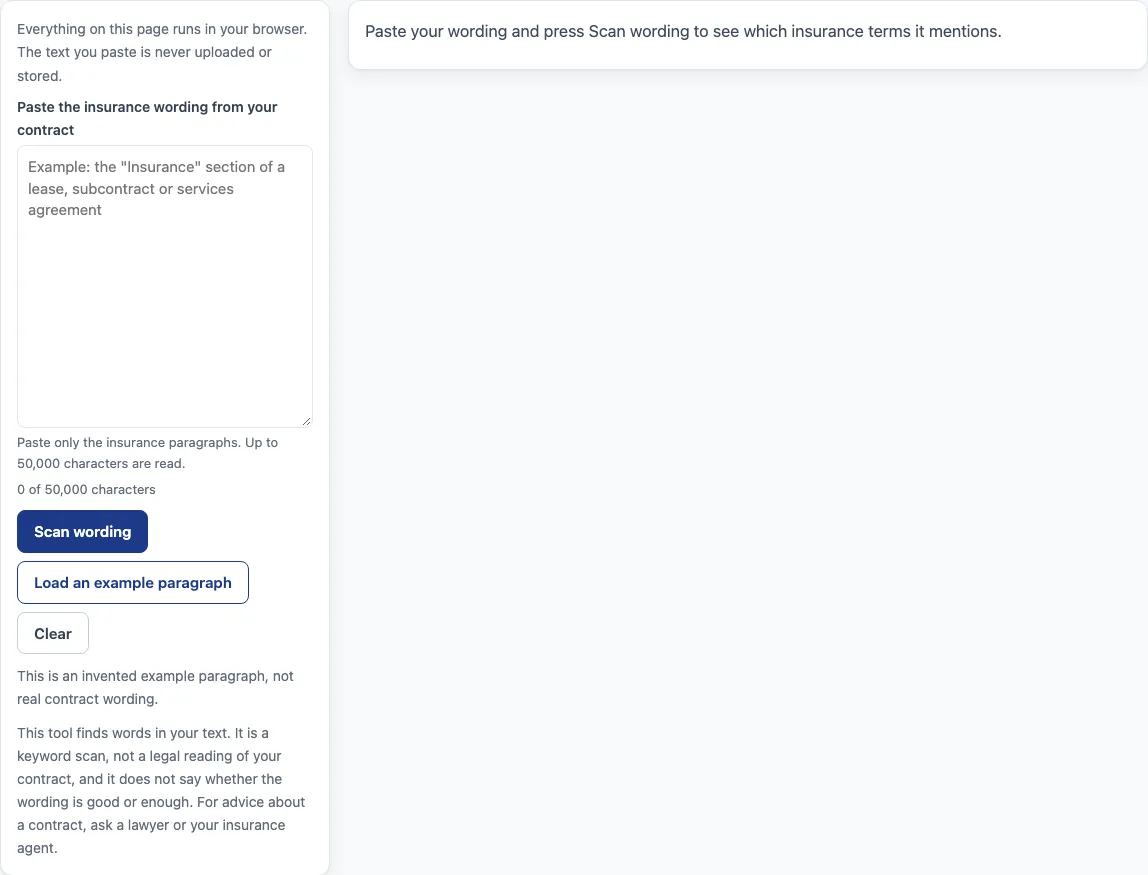
How to use the contract wording scanner
- Copy only the insurance paragraphs from your contract. A lease, subcontract or services agreement usually has an “Insurance” section.
- Paste them into the box labelled “Paste the insurance wording from your contract”. The scanner reads up to 50,000 characters.
- Press “Scan wording”. Results also update a moment after you stop typing.
- Read the two cards at the top, “Certificate holder and certificate of insurance” and “Additional insured”. Each shows “Found” or “Not found”, quotes from your text, “What it means” and “What to ask for”.
- Open “Other insurance terms in your text” for the rest, and check “Notice periods in your text” or “Dollar amounts in your text” if those sections appear.
- Press “Load an example paragraph” to see a scan of an invented example, or “Clear” to empty the box and start again.
The scanner looks only for words and phrases in the text you paste. It reports what the text mentions, quotes the words it found, and lists amounts and notice periods as written. It does not read the contract as a lawyer would, does not say whether any limit is enough, and does not check the insurer or any certificate. A term can be flagged from an unrelated sentence, and wording it does not recognize is reported as “Not found”. Treat the result as a list of questions to ask.
What is the difference between a certificate holder and an additional insured?
The certificate holder is the party named on a certificate of insurance. A certificate of insurance is a document that provides evidence that certain general types of insurance and limits have been purchased, and it is issued on behalf of the party that has to show it carries insurance. An additional insured is different. It is a person or organization that is not automatically an insured under a policy, but is added as an insured at the named insured’s request, such as a project owner, customer or landlord. The additional insured usually gets the rights of an insured under the other party’s general liability policy, and this is usually paired with an indemnity agreement.
Does being a certificate holder give me coverage?
Not by itself. A certificate is not a policy. It does not amend, extend or alter the coverage of the policy it refers to, and it does not give anyone new rights beyond what the policy expressly provides. The standard certificate form says, in its printed text, that it is issued for information only and confers no rights on the certificate holder. Naming a contract number or description on the certificate does not make the policy meet the contract’s insurance terms. The NCOIL model act says the same, but it is a model for state legislatures, and state law varies. Coverage for a named party, if there is any, comes from the policy and its endorsements.
How does someone become an additional insured?
Additional insured status can come from provisions in the policy or from an endorsement, which is a form attached to the policy that changes its terms. ISO form CG 20 10 covers ongoing operations and CG 20 37 covers completed operations. A retailer’s listing describes both as limited to liability caused in whole or in part by the named insured’s acts or omissions, and subject to the policy’s exclusions, conditions and limits. That listing is a secondary source, so check the edition printed on your policy. Taft Law writes that additional insured rights “depend entirely on the terms of the specific endorsement.” The standard certificate form also says that if a holder is an additional insured, the policy needs additional insured provisions or an endorsement, and a statement on the certificate does not replace them.
Sources (checked 16 October 2026): IRMI glossary: certificate of insurance · IRMI glossary: additional insured · NCOIL Certificates of Insurance Model Act · ACORD 25 printed text (NPS copy) · Taft Law checklist · Jones endorsement listing, secondary
Frequently asked questions
What should I ask for besides the certificate?
Ask for a copy of each endorsement that gives the terms you need, with the policy number printed on it. For additional insured status, that means the endorsement itself, not only the box on the certificate. One city’s checklist asks for the same kind of endorsement evidence for additional insured, primary and waiver wording, but that is one city’s checklist, not a universal rule.
Is a certificate holder the same as an additional insured?
No. The certificate holder is named on the certificate, which is a document. An additional insured is added to the policy through an endorsement or policy wording. A contract can ask for one, the other, or both.
Does this tool tell me whether my contract is good enough?
No. It finds words in your text and quotes them. It is a keyword scan, not a legal reading, and it does not say whether the wording is good or enough. For advice about a contract, ask a lawyer or your insurance agent.
Is my text uploaded?
No. Everything runs in your browser, and the text you paste is never uploaded or stored.
Does a certificate holder get notice if the policy is cancelled?
Only if the policy or an endorsement gives that right. The standard certificate form says notice will be delivered in accordance with the policy provisions, and the NCOIL model act says a certificate cannot change the notice terms. State law varies, so ask your agent whether the policy gives the holder notice.
Related pages on this site:
- Certificates of insurance - the hub for every certificate tool here.
- Additional insured endorsement - when the contract asks for additional insured status.
- Waiver of subrogation - when the contract asks you to waive recovery rights.
- Primary and noncontributory - when the contract asks which policy pays first.
- ACORD 25 checker - when you want to compare a certificate with the requirements.
- How to read a certificate of insurance - when you have a certificate and want to know what each box says.
- Insurance requirements letter generator - write down the coverage you ask a subcontractor or vendor to carry.
- Certificate of insurance sample - a made-up certificate explained part by part.