Bakery insurance cost
Pick a coverage to see the published figure, type a quote to compare, and tick coverages to add up a yearly budget.
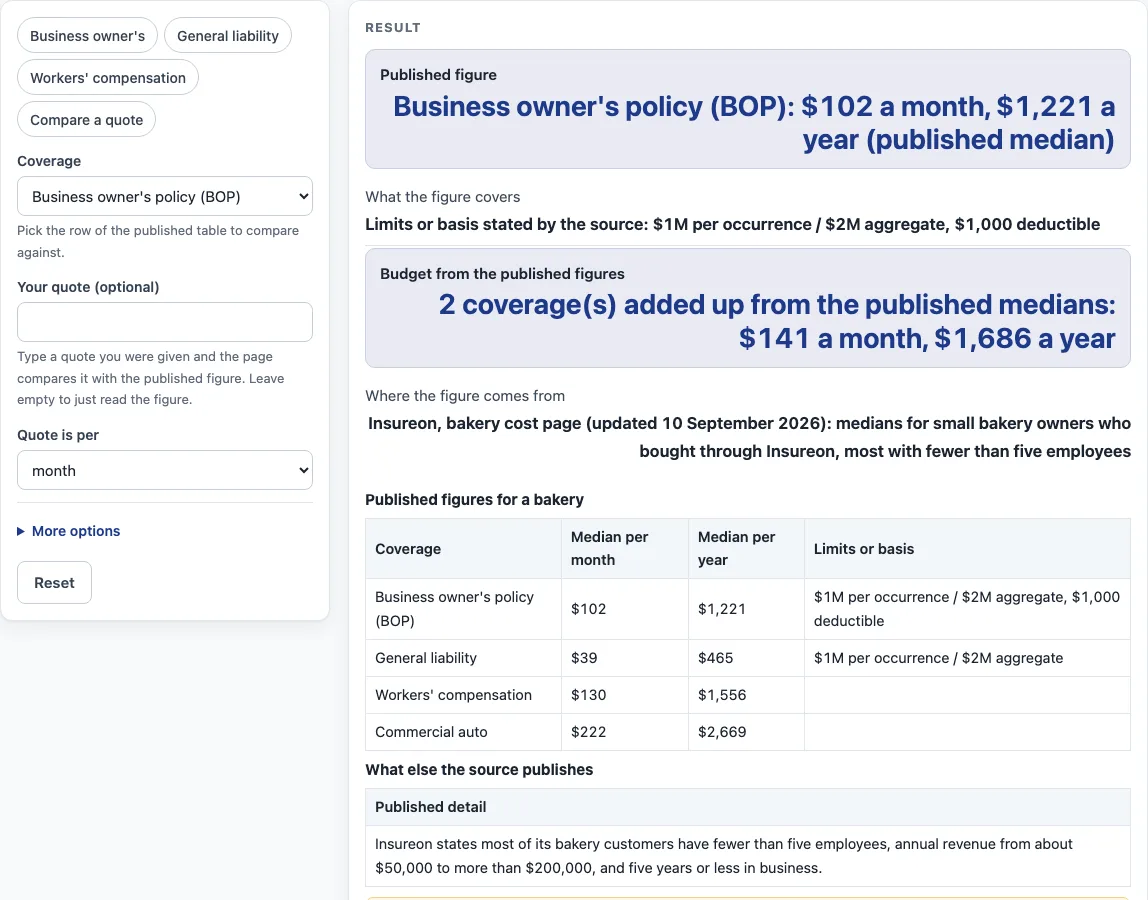
How to use the bakery insurance cost tool
- Find the row in the published table for the coverage you want to check: “Business owner’s policy (BOP)”, “General liability”, “Workers’ compensation” or “Commercial auto”.
- Read the published figure per month and per year for that row. Where the source states them, the limits appear too. The BOP row lists $1M per occurrence / $2M aggregate and a $1,000 deductible. The general liability row lists $1M per occurrence / $2M aggregate.
- If you have a quote, type it into the quote field and choose “per month” or “per year”. Check the period on your quote first, because the comparison depends on it.
- Compare like with like. Check a general liability quote against the general liability row, and a workers’ compensation quote against the workers’ compensation row.
- Read how far the quote is above or below the published figure for that row.
- Open “More options” and enter annual revenue, the number of employees, and which coverages to add to the budget.
- Read the share of revenue and the amount per employee. These appear only when you have typed the values they are based on.
Keep in mind that each row is a separate figure. Results for one coverage do not add up to a price for a package of coverages.
What do the published bakery insurance cost figures measure?
The figures are published medians from Insureon’s bakery cost page, updated 10 September 2026. They describe small bakery owners who bought through Insureon, most with fewer than five employees. Each coverage has its own row, shown per month and per year, with limits where the source states them.
Which bakeries are in the source data?
Insureon states that most of its bakery customers have fewer than five employees, annual revenue from about $50,000 to more than $200,000, and five years or less in business. If your bakery sits outside those ranges, treat the comparison with extra care, because the published figures may not describe your situation.
Why is adding the figures together not the price of a bundle?
Each figure is a median for one coverage on its own. The published per-year medians are $1,221 for the BOP, $465 for general liability, $1,556 for workers’ compensation and $2,669 for commercial auto. Adding them gives $5,911, but a sum of separate medians is not the price of a bundle, and the page says so.
How is a quote compared with the published figure?
The difference is the quote minus the published figure for the same row. To compare fairly, both amounts must cover the same period. A monthly amount can be turned into a yearly amount by multiplying it by 12. The tool shows the result as a percentage above or below the published yearly figure, and a quote that matches it is reported as matching.
How are share of revenue and amount per employee worked out?
Share of revenue is the yearly total of the coverages ticked for the budget divided by annual revenue, shown as a percentage. Amount per employee is that same yearly total divided by the number of employees. Both depend on the values you type under “More options”, so they are only shown once those values are entered.
Does the source say median or average?
The source uses both words. Its methodology says median, and elsewhere the page says average. This tool reports the figures as published medians from Insureon, so it does not call them averages. A median is the middle value in a set of numbers, which is why it can differ from an average. The tool does not explain why a quote differs from a median for your particular business.
Sources (checked 15 October 2026): insureon.com
Worked examples
| Input | Result |
|---|---|
| Business owner's policy (BOP) | 2 coverage(s) added up from the published medians: $141 a month, $1,686 a year |
| Business owner's policy (BOP), quote $130 per month | Your quote of $130 a month ($1,560 a year) is 27.8% above the published median of $102 a month. |
| General liability, revenue $120,000 | 2 coverage(s) added up from the published medians: $141 a month, $1,686 a year |
| Business owner's policy (BOP), revenue $150,000 | 2 coverage(s) added up from the published medians: $141 a month, $1,686 a year |
Calculated by the tool above; open it with the same values to see each step.
Frequently asked questions
Frequently asked questions
Is the bakery insurance cost shown here a quote?
No. Every figure is a published median from Insureon’s bakery cost page, updated 10 September 2026. The page adds no estimate of its own and gives no quote.
Which coverages does the tool cover?
The table includes the business owner’s policy (BOP), general liability, workers’ compensation and commercial auto. Each has its own row and its own published figure.
Does the tool recommend a coverage amount or limit?
No. It shows published limits where the source states them and compares them with a quote you type in. It does not recommend an insurer, a product, a coverage amount or a limit.
Where can I get an actual quote?
Quotes come from a licensed insurer or agent. The result of this tool is an estimate only.
Is what I type into the tool uploaded anywhere?
No. Everything is calculated in your browser, and nothing is uploaded. The page does not ask for contact details.
Why does the page use the word median in one place and average in another?
The figures in this tool are published medians. The source page uses the word average in some places, but this tool describes its figures as medians.
Related tools
- Food Truck Insurance Cost: use it when your food business operates from a mobile vehicle.
- Coffee shop insurance cost: use it when your food business is a coffee shop or café.
- Auto repair shop insurance cost: use it when your business runs a repair shop.
- Cleaning Business Insurance Cost: use it when your business provides cleaning services.
- Contractor Insurance Cost: use it when your business performs contracting work.
- Daycare Insurance Cost: use it when your business runs a childcare service.
- Business Insurance for Electricians Cost: use it when your business is an electrical trade.
- Hair salon insurance cost: use it when your business is a hair salon.
- Insurance cost by trade: Use it to see all the trade and small business cost tools in one list.
- Business insurance costs: Use it for the general business coverage cost tools.