Additional Insured Endorsement
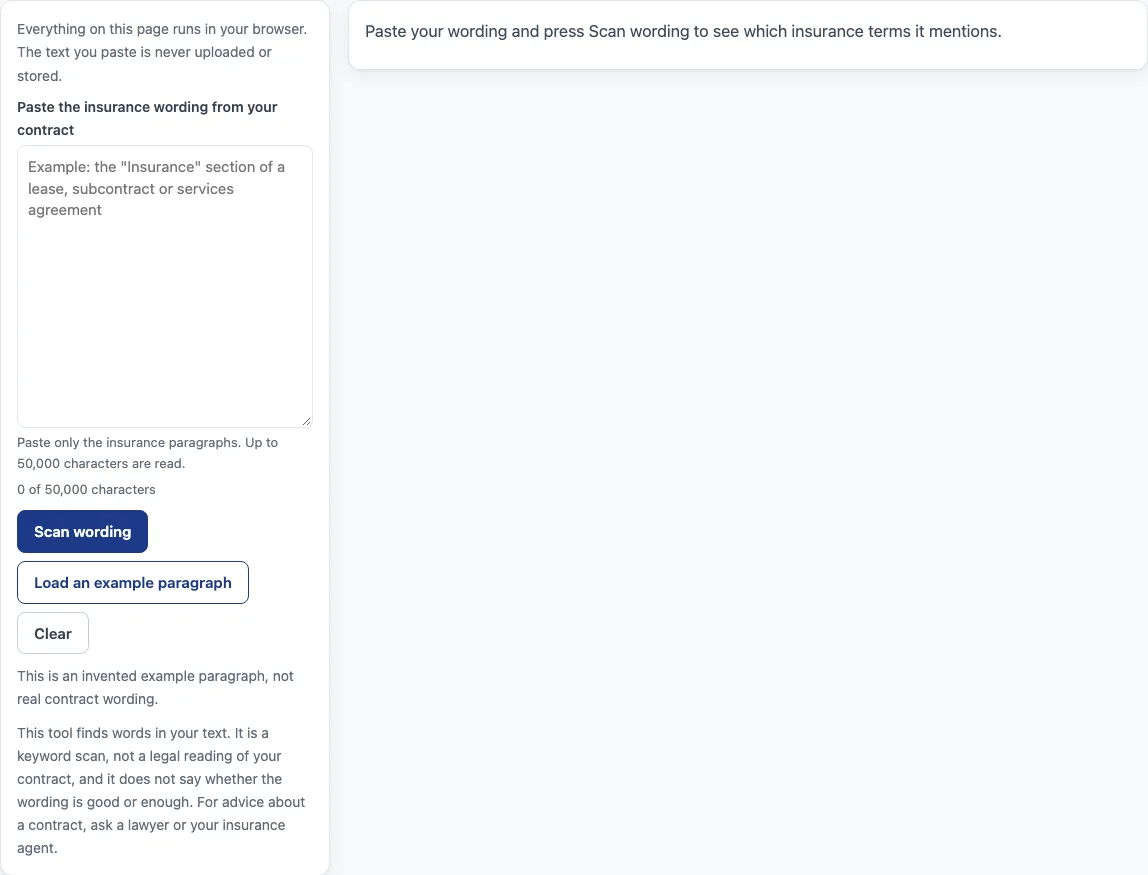
Paste the insurance wording from your contract. The page shows how it asks for additional insured status and what to look for on the endorsement itself.
How to use the additional insured scanner
Paste the insurance paragraphs from your contract into the box labelled “Paste the insurance wording from your contract”. Paste only the insurance section, such as a lease, subcontract or services agreement. To see how the tool works first, select “Load an example paragraph”, which fills the box with an invented example.
Select “Scan wording”. The results also update about 300 milliseconds after you stop typing.
Read the cards at the top. They are headed “Additional insured”, “Additional insured: ongoing operations” and “Additional insured: completed operations”. Each card shows the matching text from your paste, what the term means and a line headed “What to ask for”. Open “Other insurance terms in your text” to see the rest.
Under each card, read the line headed “What to ask for”. It tells you what document to request, such as the endorsement itself.
If “Notice periods in your text” or “Dollar amounts in your text” appear, read them as the figures your text contains. The scanner does not say whether they are enough.
Select “Clear” to empty the box and start again.
The tool reads up to 50,000 characters. It finds words and phrases, so a term can match an unrelated sentence, and wording it does not recognise is reported as “Not found”. The results are a keyword scan, not a legal reading of your contract.
What does an additional insured endorsement do?
An additional insured endorsement adds a person or organization to a liability policy as an insured, usually at the named insured’s request. Typical additional insureds are project owners, customers and landlords. They usually get the rights of an insured under the named insured’s general liability policy.
What the added party actually gets depends entirely on the terms of that endorsement. A law-firm checklist notes that an endorsement can forbid claims that arise after the work is finished, or apply only to incidents caused by the named insured’s negligence. Read the endorsement itself before you rely on it.
What is the difference between ongoing and completed operations additional insured endorsements?
Ongoing operations and completed operations are two separate ISO endorsement forms. A retailer’s listing, which is a secondary source, gives the titles as CG 20 10 for ongoing operations and CG 20 37 for completed operations. The listing says each one covers liability caused in whole or in part by the named insured’s acts or omissions. One city’s checklist lists both forms among the additional insured forms it accepts. Check the form number and edition printed on the policy, because the listing is not the form itself.
Does the certificate prove the endorsement exists?
No. A certificate of insurance is evidence that certain general types of insurance and limits have been purchased. It is not a policy. The NCOIL model act says a certificate does not amend or extend the policy, and it gives no new rights beyond what the policy expressly provides. State law varies, and the model is not law everywhere. The standard form is the ACORD 25. ACORD is a trademark of ACORD Corporation, and this page does not provide or copy the form. Its printed text says that a holder who is an additional insured needs the policy to have additional insured provisions or an endorsement. One city’s checklist asks for the endorsement itself, separate from the certificate, with the policy number printed on it.
Sources (checked 16 October 2026): IRMI glossary, additional insured · IRMI glossary, certificate of insurance · Taft Law bulletin · Jones listing CG 20 10, secondary · Jones listing CG 20 37, secondary · City of San Diego insurance checklist · NCOIL certificates model act · ACORD 25 printed text
Frequently asked questions
Is my text uploaded?
No. The scanner runs in your browser, and the text you paste is never uploaded or stored.
Does a certificate give the holder additional insured status?
No. Additional insured status comes from the policy or its endorsement, not from being named as the certificate holder. Ask for the endorsement itself, with the policy number printed on it.
What can limit an additional insured’s coverage?
The endorsement’s own wording can narrow it. A law-firm checklist gives examples, such as forbidding claims that arise after the work is completed, or applying only to incidents caused by the named insured’s negligence. The coverage is also subject to the policy’s exclusions, conditions and limits, and the limits shown on a certificate may have been reduced by paid claims.
Does the scan show whether my contract wording is enough?
No. The scanner is a keyword check. It does not say whether the wording is good or enough. For advice about a contract, ask a lawyer or your insurance agent.
Do form numbers CG 20 10 and CG 20 37 always mean the same thing?
Not necessarily. The titles come from a retailer’s listing and one city’s checklist, not from the insurer. The edition can differ, so check the edition printed on the policy.
Related pages on this site:
- Certificate holder vs additional insured - when a party is named on the certificate but still needs status on the policy.
- Waiver of subrogation - when a contract asks that the insurer give up its recovery rights.
- Primary and non-contributory - when a contract asks which policy responds first.
- How to read a certificate of insurance - when you want to find each box on the form.
- ACORD 25 checker - when you have a certificate to compare with the requirements.
- Insurance requirements letter - when you need to tell a party what it should send you.
- Certificate of insurance sample - when you want to see a filled-in form.
- Certificates of insurance - the hub for every certificate tool and guide on this site.